


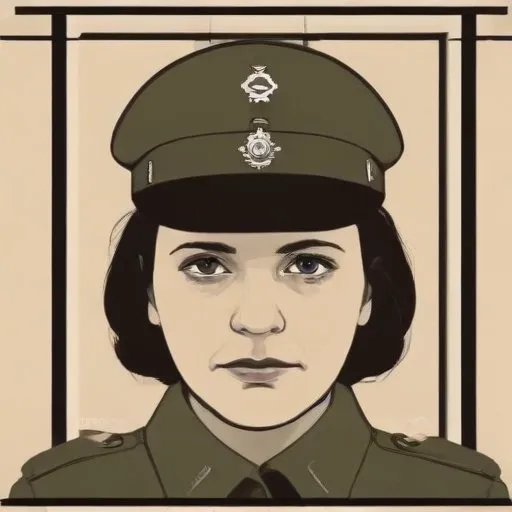
Therese Brandl was a notorious Nazi concentration camp guard during World War II, known for her brutality and role in the Auschwitz and Ravensbrück camps. Brandl was responsible for the killings of thousands of innocent people, including women and children, and was later convicted of crimes against humanity.
Brandl was born on February 1, 1902, in Staudach-Egerndach, Bavaria, Germany. She began her training as a guard at Ravensbrück concentration camp in March 1940, under the supervision of SS-Oberaufseherin Johanna Langefeld. Brandl quickly rose through the ranks, becoming an Erstaufseherin (First Guard) directly under Margot Dreschel and Maria Mandl.
In March 1942, Brandl was posted to Auschwitz I concentration camp, where she was employed in the laundry and was responsible for watching over women in the sorting sheds. She soon became infamous for her cruelty, participating in the selection of women and children to be murdered in the gas chambers. Her brutality was well-documented by survivors, including Andreas Larinciakos, a nine-year-old boy from Italy who recalled being physically abused by Brandl.
In the summer of 1943, Brandl received a medal from the Reich for her "good conduct" in the camps, a stark contrast to the atrocities she was committing. Her actions were widely recognized as reprehensible, and her presence inspired fear in the prisoners.
In November 1944, with the approach of the Soviet Army, Brandl was assigned to the Mühldorf concentration camp complex, a subcamp of Dachau. She was demoted to Aufseherin and her behavior during this period is not well-documented. Brandl ultimately fled from Mühldorf on April 27, 1945, just weeks before the arrival of the United States Army.
On August 29, 1945, the U.S. Army arrested Brandl in the Bavarian mountains of Germany and sent her to a holding camp to await questioning. In November 1947, she was put on trial for crimes against humanity during the Auschwitz Trial in Krakow and was found guilty. Brandl was executed on January 24, 1948, for her role in the Nazi regime.
Therese Brandl's actions during World War II are a stark reminder of the atrocities committed by the Nazi regime. Her brutality and willingness to participate in the murder of innocent people make her a notorious figure in history. Her conviction and execution serve as a reminder that those who commit crimes against humanity will be held accountable.
Therese Brandl's story serves as a cautionary tale about the dangers of blind obedience and the importance of standing up against injustice and cruelty.
Born in 1923
Notorious female SS officer at Auschwitz and Bergen-Belsen concentration camps, known for her brutal treatment and murder of prisoners, earning her the nickname "The Beast of Belsen".
Born in 1906
A notorious SS officer who oversaw the atrocities at Auschwitz-Birkenau and Bergen-Belsen concentration camps during World War II, earning the nickname "Beast of Belsen".
Born in 1900
Leading the SS and Gestapo, he oversaw the Nazi regime's brutal security apparatus and implemented the "Final Solution," orchestrating the genocide of six million Jews during World War II.
Born in 1904
A high-ranking Nazi officer and physician who oversaw the Nazi euthanasia program, responsible for the deaths of thousands of people with mental and physical disabilities.
Born in 1892
A ruthless and efficient administrator who oversaw the creation and operation of Nazi concentration camps during World War II, responsible for the deaths of millions of people.
Born in 1906
Notorious Nazi concentration camp commander's wife, known for her brutal and sadistic behavior, including making lampshades from human skin.
