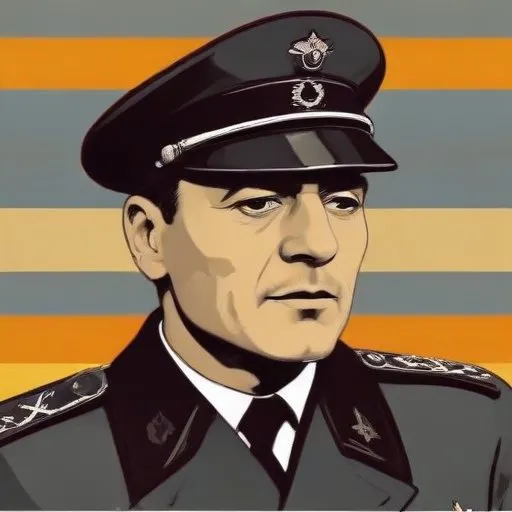
Josef Kramer

Josef Kramer

Josef Kramer was born on November 10th, 1906

Full Name: Josef Kramer
Place of Birth: Munich, Germany
Profession: German SS Officer
Notable Position: Commandant of Bergen-Belsen
Nationality: German
Active Years: 1934-1945
Criminal Charges: War Crimes
Executed: December 13, 1945

A notorious SS officer who oversaw the atrocities at Auschwitz-Birkenau and Bergen-Belsen concentration camps during World War II, earning the nickname "Beast of Belsen".

Written by: Thomas Blackwood Thomas Blackwood

Josef Kramer: The Notorious "Beast of Belsen"

Josef Kramer, a Hauptsturmführer and Commandant of Auschwitz-Birkenau and Bergen-Belsen concentration camps, was notorious for his brutality and callousness, earning him the moniker "The Beast of Belsen" among camp inmates. Directly responsible for the deaths of thousands of people, Kramer's reign of terror during World War II left an indelible mark on human history.

Early Life and Nazi Ascent

Born on November 10, 1906, in Munich, Germany, Kramer grew up in a middle-class family, the only child of Theodore and Maria Kramer. Raised as a strict Roman Catholic, Kramer's early life gave no indication of the atrocities he would later commit. In 1920, he began an apprenticeship as an electrician, which was followed by a string of unremarkable jobs until he joined the Nazi Party in 1931 and the SS in 1932.

Career of Atrocities

Kramer's rapid rise through the Nazi ranks was facilitated by his training as a prison guard and concentration camp administrator. He was assigned to Dachau in 1934, where he quickly gained promotion, eventually becoming assistant to Rudolf Höss, the Commandant of Auschwitz, in 1940.

In April 1941, Kramer took command of Natzweiler-Struthof concentration camp, a notorious site in present-day France where thousands of prisoners were subjected to forced labor, starvation, and brutal treatment.

The Beast of Belsen

In December 1944, Kramer assumed command of Bergen-Belsen concentration camp, where he continued to exercise his trademark cruelty. The camp's already dire conditions were exacerbated by Kramer's brutal discipline, resulting in rampant hunger, disease, and death.

The liberation of Bergen-Belsen by British forces on April 15, 1945, revealed the full extent of Kramer's atrocities. The camp's 60,000 prisoners, mostly Jews, were found in a state of utter despair, with 10,000 corpses scattered throughout the camp.

Trial and Execution

Kramer was arrested by British forces and put on trial for war crimes. The extent of his brutalities was exposed during the trial, and on December 13, 1945, he was hanged on the gallows in the prison at Hamelin by British executioner Albert Pierrepoint.

Legacy of Horror

Josef Kramer's crimes against humanity are a stark reminder of the depths to which humanity can sink. His brutal legacy serves as a cautionary tale, underscoring the dangers of unchecked power, prejudice, and hatred.

Though Kramer's atrocities are irredeemable, his story serves as a testament to the importance of remembering and learning from the darkest chapters of human history, in the hopes of preventing such horrors from recurring.

Timeline
1906
Birth of Josef Kramer
German SS officer Josef Kramer was born in Munich, Germany.
1934
Joins the SS
Kramer joins the SS, rising through the ranks to become a notorious concentration camp commandant.
1944
Becomes Commandant of Bergen-Belsen
Kramer becomes the commandant of Bergen-Belsen concentration camp, where he is responsible for atrocities.
1945
Captured by the British
Kramer is captured by the British Army and put on trial for war crimes.
1945
Execution
Josef Kramer is executed for his war crimes.
Josef Kramer

Josef Kramer Quiz

What was Josef Kramer's notorious nickname during World War II?

Score: 0/5
FAQ
What was Josef Kramers role in the German SS?
Josef Kramer was a German SS officer who played a significant role in the Nazi regime. He served as the commander of several concentration camps, including Auschwitz and Bergen-Belsen.
What was Josef Kramers involvement in the Holocaust?
Josef Kramer was deeply involved in the Holocaust, the systematic persecution and extermination of six million Jews and millions of other people by the Nazi regime. He oversaw the mass murder of countless people at the concentration camps he commanded.
How did Josef Kramers actions contribute to the atrocities of World War II?
Josef Kramers actions were a significant contributor to the atrocities of World War II. He was a willing participant in the Nazi regimes genocidal policies, and his brutal treatment of prisoners and his role in the mass murder of innocent people are a stain on human history.
What was Josef Kramers fate after the war?
Josef Kramer was captured by the Allies after the war and put on trial for war crimes. He was found guilty and executed in 1945.
What is Josef Kramers legacy in history?
Josef Kramers legacy in history is that of a war criminal and a perpetrator of genocide. His actions are a reminder of the horrors of the Holocaust and the dangers of totalitarian regimes.

Related People:

Heinrich Himmler

Born in 1900

Leading the SS and Gestapo, he oversaw the Nazi regime's brutal security apparatus and implemented the "Final Solution," orchestrating the genocide of six million Jews during World War II.

Adolf Eichmann

Born in 1906

A high-ranking Nazi officer responsible for organizing the logistics of the Holocaust, overseeing the mass deportation of Jews to concentration camps during World War II.

Karl Brandt

Born in 1904

A high-ranking Nazi officer and physician who oversaw the Nazi euthanasia program, responsible for the deaths of thousands of people with mental and physical disabilities.

Theodor Eicke

Born in 1892

A ruthless and efficient administrator who oversaw the creation and operation of Nazi concentration camps during World War II, responsible for the deaths of millions of people.

Ernst Kaltenbrunner

Born in 1903

Austrian-German lawyer and general who served as the highest-ranking leader of the Nazi police forces, responsible for overseeing the Gestapo, SS, and concentration camps during World War II. He was a key figure in the Holocaust and other atrocities committed by the Nazi regime.

Richard Glücks

Born in 1889

High-ranking SS officer responsible for overseeing the administration of concentration camps during World War II, implementing brutal policies and overseeing mass atrocities.

Fritz Sauckel

Born in 1894

A German sailor-turned-politician who played a key role in the Nazi regime, particularly in organizing forced labor during World War II. He was later tried and executed for war crimes.

Hermann Göring

Born in 1893

A high-ranking Nazi official, he was a decorated World War I fighter pilot and later became a prominent politician, serving as Minister President of Prussia. He's infamous for his role in the Nazi regime and war crimes trials.