


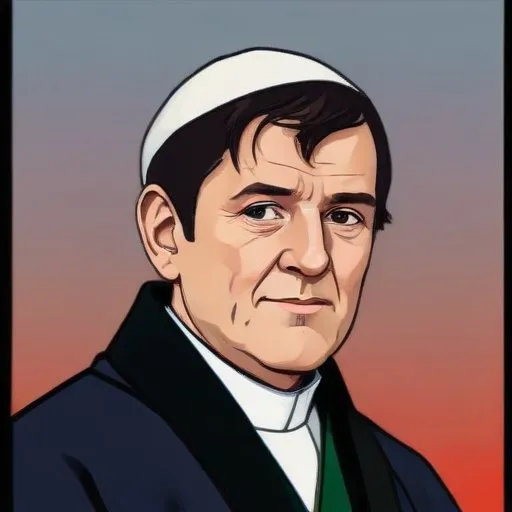
A Scottish-born Irish minister and theologian who played a key role in the Restoration Movement, seeking to unify Christians and restore the church to its New Testament roots. He's known for his writings on Christian unity and his efforts to move beyond denominational divisions.
Thomas Campbell, a Scottish poet, is best known for his didactic poem "Pleasures of Hope" and his patriotic war songs that stirred the hearts of many during the tumultuous 18th century. His poetic legacy is a testament to his boundless imagination, intellectual curiosity, and love for his nation.
Born on High Street, Glasgow in 1777, Thomas Campbell was the youngest of eleven children to Alexander Campbell, a descendant of the MacIver-Campbells, and Margaret Campbell, daughter of John Campbell of Craignish. His father, a merchant, lost his property during the American Revolutionary War, leaving the family in financial ruin. This early exposure to adversity would later shape Campbell's writing style and thematic focus.
Despite the challenges, Campbell's parents instilled in him a love for literature and music. He received his education at the High School of Glasgow and the University of Glasgow, where he excelled in classics and verse-writing, winning prizes for his exceptional skills.
Campbell's most notable work, "Pleasures of Hope," published in 1799, is a traditional 18th-century didactic poem in heroic couplets. This masterpiece showcases his poetic prowess and his ability to craft verses that inspire and educate. His other notable works include:
These patriotic war songs and poems resonated with the British public, bolstering national morale during times of conflict. Campbell's writing is characterized by its accessibility, passion, and intellectual depth, making him a celebrated poet of his era.
Campbell's poetry often explored themes of hope, patriotism, and the human condition. His philosophical inclinations leaned towards the didactic, seeking to educate and inspire his readers. He believed in the power of poetry to shape public opinion and to promote noble ideals.
In addition to his literary achievements, Campbell was a founder and the first President of the Clarence Club and a co-founder of the Literary Association of the Friends of Poland. He was also one of the initiators of a plan to found what became University College London.
Thomas Campbell's poetry had a significant impact on British literature and society. His patriotic war songs and poems helped to shape public opinion and fostered a sense of national identity. His didactic style and thematic focus on hope and patriotism continue to inspire writers and thinkers to this day.
In conclusion, Thomas Campbell's remarkable life and literary contributions have left an indelible mark on the world of poetry and beyond. His vision, passion, and intellectual curiosity continue to inspire generations, cementing his legacy as one of Scotland's most celebrated poets.
Born in 1759
Celebrated for his poignant and lyrical poetry, he penned iconic works that capture the essence of Scottish culture and identity. His contributions to literature continue to inspire and delight readers worldwide.
Born in 1771
A renowned author of historical novels, plays, and poetry, credited with creating the genre of historical fiction and influencing the development of the novel as a literary form.
Born in 1850
A Scottish novelist, poet, and essayist who wrote iconic adventure novels, including "Treasure Island" and "Dr. Jekyll and Mr. Hyde", that have captivated readers for generations.
97 Years Old
Veteran actor and director with a prolific career spanning over 60 years, known for his iconic roles in films like "Blade Runner" and "Big Trouble in Little China".
Born in 1795
Romantic poet celebrated for sensual language and vivid imagery, capturing the beauty of nature and human experience in odes like "To Autumn" and "Ode to a Nightingale".
Born in 1792
Romantic-era writer of lyrical poetry and Gothic dramas that explored the human condition, freedom, and the beauty of nature.
Born in 1788
Romantic poet and playwright celebrated for passionate, expressive works that explored themes of love, freedom, and the human condition.
Born in 1774
A leading Romantic poet and historian, known for his vivid storytelling and influential works on British history, particularly his three-volume "Life of Nelson".
