


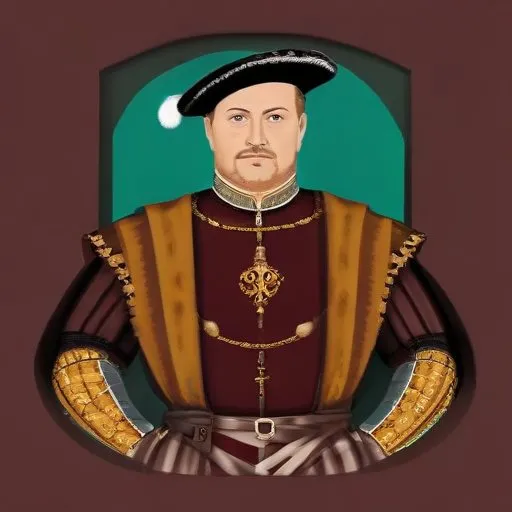
A loyal knight and nobleman who served as a prominent military leader and advisor to King Henry VIII, known for his bravery and strategic prowess in battle.
Thomas Dacre, 2nd Baron Dacre of Gilsland, is renowned for his valiant efforts as a military commander, diplomat, and administrator, who played a pivotal role in maintaining peace and stability along the tumultuous border between England and Scotland during the late 15th and early 16th centuries.
Born on November 25, 1467, in Cumberland, Thomas Dacre was the eldest son of Humphrey Dacre, 1st Baron Dacre of Gilsland, and Mabel Parr. Following his father's death in 1485, Thomas succeeded him as Baron Dacre of Gilsland, becoming one of the most powerful noblemen in the North of England.
In 1485, Thomas Dacre fought on the Yorkist side against Henry Tudor at the Battle of Bosworth, where the Yorkist king, Richard III of England, was defeated and killed. Despite his initial allegiance to the losing side, Dacre swiftly made peace with the victor, Henry Tudor, who would eventually become King Henry VII of England. This early display of pragmatism earned Dacre the trust of the new monarch, who would continue to rely on his services throughout his reign.
In 1503, King Henry VII named Thomas Dacre a Knight of the Bath, recognizing his loyalty and military prowess. When Henry VIII ascended to the throne in 1509, Dacre pledged his allegiance to the new king, further solidifying his position as a trusted noble and military commander. As Warden of the Western Marches, Dacre played a crucial role in maintaining peace and security along the English-Scottish border, often engaging in diplomatic efforts to prevent conflicts and protect English interests.
In 1513, Thomas Dacre led the Border Lancers at the Battle of Flodden, where the English army decisively defeated the invading Scottish forces, resulting in the death of King James IV of Scotland. Dacre's bravery and tactical acumen during the battle earned him further recognition and accolades from King Henry VIII, cementing his reputation as a skilled military commander and capable administrator.
Throughout his remarkable life, Thomas Dacre, 2nd Baron Dacre of Gilsland, proved himself to be a shrewd diplomat, courageous military commander, and capable administrator, whose unwavering commitment to the English crown and his own people left an indelible mark on the tumultuous history of the English-Scottish borderlands.
Born in 1491
A larger-than-life monarch who ruled England with an iron fist, infamous for his six marriages and the English Reformation.
Born in 1489
Leader of the English Reformation, instrumental in creating the Church of England and authoring the Book of Common Prayer.
Born in 1478
A renowned Renaissance humanist and statesman who served as Lord Chancellor of England, famous for his literary work "Utopia" and his martyrdom for refusing to acknowledge the English monarch's supremacy over the Church.
Born in 1284
The king whose disastrous reign led to his eventual deposition and mysterious death, remembered for his alleged homosexual relationships and power struggles with nobles.
Born in 1516
The first queen to rule England in her own right, Bloody Mary tried to restore Catholicism, earning her notorious reputation for burning hundreds of Protestants at the stake.
Born in 1533
The Virgin Queen, a powerful and beloved monarch, ruled England during a golden age of culture, literature, and exploration, establishing the Church of England and defeating the Spanish Armada.
Born in 1574
An English explorer and cartographer who mapped the New World and created innovative navigational tools, contributing significantly to the development of modern cartography.
