


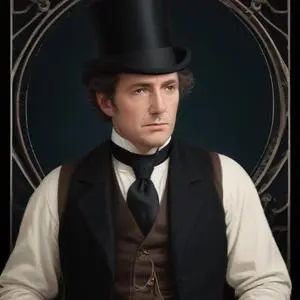
Pioneering researcher who made groundbreaking contributions to the fields of optics, physiology, and Egyptology, including deciphering ancient hieroglyphics and proposing the wave theory of light.
Thomas Young is renowned for his groundbreaking contributions to various fields, including vision, light, solid mechanics, energy, physiology, language, musical harmony, and Egyptology. He is particularly celebrated for deciphering Egyptian hieroglyphs, specifically the Rosetta Stone, earning him the title "The Last Man Who Knew Everything."
Born on June 13, 1773, in Milverton, Somerset, England, Young was the eldest of ten children in a Quaker family. By the age of fourteen, he had already mastered Greek, Latin, French, Italian, Syriac, Samaritan Hebrew, Arabic, Biblical Aramaic, Persian, Turkish, and Geez.
Young pursued his passion for medicine, studying at St Bartholomew's Hospital in London in 1792, followed by the University of Edinburgh Medical School in 1794. He later moved to Göttingen, Lower Saxony, Germany, where he earned his doctorate in medicine from the University of Göttingen in 1796.
In 1797, Young entered Emmanuel College, Cambridge, and soon inherited the estate of his granduncle, Richard Brocklesby, making him financially independent. He established himself as a physician at 48 Welbeck Street, London, and began publishing academic articles anonymously to protect his reputation as a physician.
In 1801, Young became a professor of natural philosophy (mainly physics) at the Royal Institution, delivering an impressive 91 lectures within two years. He was appointed foreign secretary of the Royal Society in 1802, a position he held until 1829.
Young's most notable contributions include:
Young's work had a profound impact on subsequent scientists, including William Herschel, Hermann von Helmholtz, James Clerk Maxwell, and Albert Einstein. His theories and discoveries paved the way for significant advancements in various fields.
His wave theory of light, supported by Augustin-Jean Fresnel's work, revolutionized the understanding of light and its behavior. This, in turn, influenced the development of modern optics, spectroscopy, and other related fields.
Young's intellectually curious nature and relentless pursuit of knowledge earned him the title "The Last Man Who Knew Everything." His remarkable contributions to various fields have left an indelible mark on the scientific community.
Young's legacy extends beyond his scientific achievements, as he remains an inspiration to individuals who aspire to excel in multiple fields. His remarkable life serves as a testament to the power of human curiosity, dedication, and passion.
"The most essential thing in life is to learn how to give out love, and let it come in." - Thomas Young
This quote reflects Young's emphasis on the importance of love, compassion, and kindness in human relationships, highlighting his compassionate and empathetic nature.
Young was elected a Fellow of the Royal Society in 1794 and served as its foreign secretary from 1802 to 1829. He was also a member of the Royal Institution, where he held the position of professor of natural philosophy.
Did you know that Thomas Young was a talented musician and composed music in his spare time?
Young's remarkable language skills enabled him to converse in multiple languages, including Arabic, Persian, and Turkish.
He was known for his kind and compassionate nature, often providing medical assistance to those in need, regardless of their social status.
Born in 1791
Pioneering scientist who discovered electromagnetic induction, formulated the laws of electrolysis, and invented the first electrical generator, revolutionizing our understanding of electricity and its applications.
Born in 1831
Developed groundbreaking theories that unified electricity and magnetism, and predicted the existence of radio waves, revolutionizing our understanding of the physical world.
Born in 1775
A pioneer in the field of electromagnetism, he formulated fundamental laws that describe the relationship between electric currents and magnetic fields. His work laid the foundation for many modern technologies, including electric motors and generators.
Born in 1777
A pioneer in mathematics and physics, he made major contributions to number theory, algebra, and electromagnetism, shaping our understanding of the natural world.
Born in 1745
Italian physicist who invented the first electrical battery, revolutionizing the field of electricity and paving the way for countless technological advancements.
Born in 1778
Pioneering chemist and physicist who discovered several elements, including potassium and sodium, and invented the Davy lamp, a safety lamp for miners. His groundbreaking work laid the foundation for modern chemistry and electrochemistry.
Born in 1803
Developed the Doppler effect, a principle that explains how the frequency of light or sound waves changes when the source is moving relative to the observer. This concept is crucial in astronomy, radar technology, and medical imaging.
