


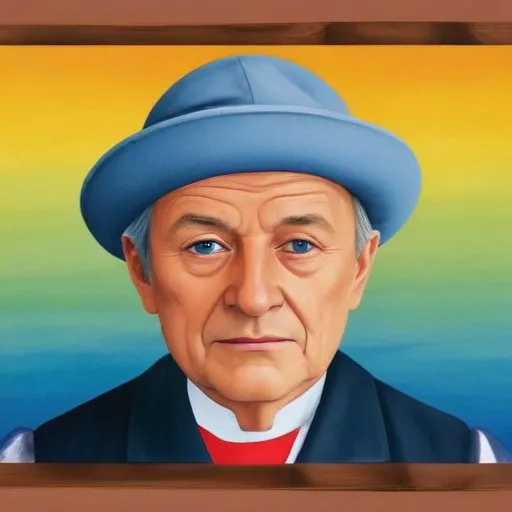
A 16th-century Dutch historian and geographer who wrote extensively on the history and geography of the Netherlands, particularly the province of Groningen. He's most known for his detailed descriptions of the region's landscape, culture, and people.
Ubbo Emmius, a German historian and geographer, is renowned for his monumental work on the History of the Frisian Territories, a six-part magnum opus that earned him the title of "Father of Frisian Historiography." His contributions to historiography have left an indelible mark on the field, making him a household name in academic circles.
Born on December 5, 1547, in Greetsiel, East Frisia, Ubbo Emmius was the son of a Lutheran preacher. His early education took place in a Latin school, where he excelled until the age of 18. Following his father's death, Emmius shifted to Rostock for further education. At 30, he migrated to Geneva, where he studied under the tutelage of Theodorus Beza, a prominent Calvinist scholar who greatly influenced Emmius' worldview.
Emmius' academic prowess earned him the position of rector at the Latin school in Norden, East Friesland, where he had once been a student. Although he was later dismissed due to his Calvinist beliefs, he went on to become the rector of the Latin school in Leer, where he remained until 1594. During this period, he corresponded with prominent figures of the time, including those who had fled from Groningen after the Spanish invasion.
Emmius' most notable works include:
In 1614, Emmius played a pivotal role in the founding of the University of Groningen, where he was appointed as the principal and professor of history and Greek. He later became the first rector magnificus of the Academy, cementing his legacy in the world of academia.
Ubbo Emmius' contributions to historiography have had a profound impact on our understanding of the past. His works have inspired generations of scholars, earning him a revered place in the annals of academic history. Today, the Ubbo Emmius Gymnasium in Leer, a school he once led, stands as a testament to his enduring legacy.
Emmius' life serves as a testament to the power of dedication and perseverance. Despite facing challenges and setbacks, he remained committed to his craft, leaving behind a rich intellectual heritage that continues to enrich our understanding of the world.
Born in 1551
Renowned for meticulously documenting England's antiquities and historical sites, this 16th-century scholar authored Britannia, a seminal work that shaped the country's understanding of its past.
Born in 1512
A Flemish mathematician, cartographer, and philosopher who developed the Mercator projection, a cylindrical map projection that preserves angles and shapes well, revolutionizing navigation and cartography.
Born in 1527
A Flemish cartographer and geographer who created the first modern atlas, revolutionizing navigation and exploration. His work laid the foundation for modern cartography.
Born in 1629
A 17th-century polymath who made groundbreaking contributions to optics, probability theory, and astronomy, including the discovery of Saturn's rings and the largest moon, Titan.
Born in 1596
A 17th-century Dutch master of words and music, known for his lyrical poetry and innovative compositions that blended French and Italian styles. He was a true Renaissance man, excelling in multiple artistic fields.
Born in 1583
A 17th-century philosopher and jurist who laid the foundations for modern international law, particularly the concept of "just war" and the laws of the sea.
Born in 1466
A 16th-century Renaissance humanist who advocated for education, tolerance, and critical thinking, and is famous for his witty and insightful writings, particularly "In Praise of Folly".
