


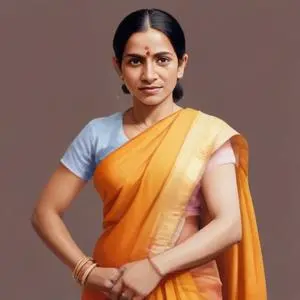
A key figure in India's struggle for independence, known for her fearless activism and leadership in the Quit India Movement, inspiring countless others to join the fight.
Usha Mehta, a Gandhian and independence activist, is renowned for organizing the Congress Radio, an underground radio station that courageously broadcasted anti-British sentiments during the Quit India Movement of 1942. This pioneering effort earned her the esteemed Padma Vibhushan, the second-highest civilian award of the Republic of India, in 1998.
Born on March 25, 1920, in Saras, a village near Surat in Gujarat, Usha's life was deeply influenced by Mahatma Gandhi's ideals. At just five years old, she had her first encounter with Gandhi at his ashram in Ahmedabad. This encounter sparked a fire within her, and she soon found herself participating in protest marches and spinning sessions organized by Gandhi.
In 1928, eight-year-old Usha took part in a protest march against the Simon Commission, boldly shouting "Simon Go Back!" Her fervor only grew stronger, and she began participating in early morning protests against the British Raj and picketing in front of liquor shops. When policemen charged at the children during one of these protests, Usha and her fellow young revolutionaries took the story to their parents, who responded by dressing them in the colors of the Indian flag and sending them back out into the streets.
Usha's father, a judge under the British Raj, discouraged her participation in the freedom struggle. However, this limitation was lifted when he retired in 1930. His earlier reluctance only fueled Usha's determination, and she continued to participate in the freedom movement with renewed vigor.
In 1932, Usha's family moved to Bombay, where she actively engaged in distributing clandestine bulletins and publications. Her unwavering commitment to the cause earned her recognition as a prominent figure in the Quit India Movement. Her work with the Congress Radio, however, remains her most enduring legacy.
Operating clandestinely, the Congress Radio broadcasted messages of resistance and hope to a nation struggling under British rule. Usha's efforts, along with those of her fellow revolutionaries, inspired countless Indians to join the fight for independence. Though the radio station functioned for only a few months, its impact on the movement was immense.
In recognition of her contributions to India's struggle for independence, Usha Mehta was awarded the Padma Vibhushan in 1998. This prestigious honor is a testament to her unwavering dedication to the cause of freedom and her role as a pioneering female figure in the Indian independence movement.
Usha Mehta's life serves as a powerful reminder of the importance of courage, conviction, and sacrifice. Her unwavering commitment to the cause of Indian independence continues to inspire generations of Indians and freedom fighters around the world. Through her life and work, she has left an indelible mark on India's struggle for independence, and her legacy will forever be etched in the annals of Indian history.
Born in 1892
A close associate of Mahatma Gandhi, this Indian author and activist was a key figure in the Indian independence movement, known for his writing and activism that helped shape the country's struggle for freedom.
Born in 1879
A pioneering Indian poet and activist who used her lyrical voice to advocate for women's rights and Indian independence, leaving a lasting legacy in Indian literature and politics.
Born in 1889
India's first Prime Minister, a key figure in the country's struggle for independence from British rule, and a champion of democracy and secularism. He played a crucial role in shaping modern India's government and economy.
Born in 1875
Indian lawyer and politician who played a key role in India's struggle for independence and later became the country's first Deputy Prime Minister, known for his strong leadership and unification of the country.
Born in 1897
Indian freedom fighter and politician who led the Indian National Army against British rule and was a key figure in the country's struggle for independence. He is also known for his mysterious disappearance in 1945.
Born in 1884
India's first president, a key figure in the country's struggle for independence, who played a crucial role in shaping the nation's early years. He's revered for his leadership and commitment to democracy.
Born in 1888
A key figure in India's struggle for independence, he played a crucial role in shaping the country's education system and promoting unity among its diverse population.
Born in 1865
A leading figure in India's struggle for independence from British rule, known for his role in the Indian independence movement and his advocacy for Hindu-Muslim unity.
