


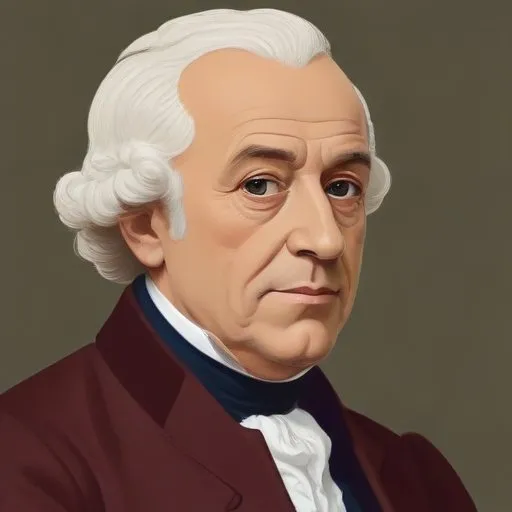
A pioneering economist and educator who advocated for free trade, economic liberalism, and education reform, leaving a lasting impact on modern economic thought.
Victor de Riqueti, Marquis de Mirabeau, is renowned as one of the most influential economists of the Physiocratic school, a prominent figure in 18th-century France. He is best known for his groundbreaking works on political economy, particularly his magnum opus, L'Ami des Hommes, which advocated for a return to a more agrarian society and limited government intervention in the economy.
Born on October 5, 1715, in Pertuis, Victor de Riqueti was raised in a stern household by his father. In 1728, he joined the army, where he developed a passion for campaigning, but his inability to secure a promotion to a higher rank led to his disillusionment with the military. He eventually inherited the family property after his father's death in 1737.
During the 1740s, Mirabeau formed close relationships with prominent literary figures, including Luc de Clapiers, Marquis de Vauvenargues, and the poet Lefranc de Pompignan. It was during this period that he became acquainted with Richard Cantillon's Essai sur la Nature du Commerce en Général, which significantly influenced his future works. In 1743, he married Marie-Geneviève, daughter of Brigadier M. de Vassan, in pursuit of landed estates, and was made a Knight of the Royal and Military Order of St. Louis.
Mirabeau's work on Cantillon's manuscript sparked his interest in political economy, and he began to develop his own ideas on the subject. He wrote his first work, Testament Politique, in 1747, which called for the French noblesse to return to their medieval roots. This was followed by Utilité des États Provinciaux in 1750, which further solidified his position as a pioneering economist.
In 1749, Mirabeau's son, Honoré Gabriel Riqueti, Comte de Mirabeau, was born. The younger Mirabeau would go on to become a celebrated orator and politician, earning the nickname "The Tribune of the People." Victor de Riqueti died on July 13, 1789, in Argenteuil, leaving behind a legacy as one of the most influential economists of the 18th century.
Mirabeau's economic philosophy was rooted in the principles of the Physiocratic school, which emphasized the importance of agriculture and limited government intervention in the economy. He believed that the prosperity of France lay in the return to a more agrarian society, where the land was the primary source of wealth.
Mirabeau's works had a significant impact on the development of modern economics, influencing prominent economists such as Adam Smith and François Quesnay. His ideas on the importance of agriculture and the limitations of government intervention continue to shape economic discourse today.
V Victor de Riqueti, Marquis de Mirabeau, played a crucial role in shaping the economic landscape of 18th-century France. His contributions to the Physiocratic school paved the way for a new era of economic thought, and his legacy continues to inspire economists and policymakers to this day.
Victor de Riqueti, Marquis de Mirabeau, was a trailblazing economist who left an indelible mark on the development of modern economics. His contributions continue to influence economic thought, and his legacy serves as a testament to the power of innovative ideas and intellectual curiosity.
61 Years Old
A lawyer and politician who served in the U.S. House of Representatives from 1987 to 1997, known for his moderate Republican views and advocacy for environmental issues.
Born in 1767
A French economist and academic who developed the concept of entrepreneurship and is credited with coining the term "economist," making significant contributions to classical economics. He is also known for Say's Law, which states that "supply creates its own demand."
Born in 1772
A British economist and politician who developed the concept of comparative advantage, which revolutionized international trade and shaped modern economic theory.
Born in 1806
A prominent 19th-century thinker who championed individual liberty, free speech, and women's rights, and is best known for his influential book "On Liberty".
Born in 1818
A 19th-century philosopher who developed the theory of communism, arguing that capitalism would eventually be replaced by a socialist society. He's known for his critique of capitalism and the concept of class struggle.
Born in 1899
Austrian economist and philosopher who championed free market capitalism and limited government intervention, warning of the dangers of socialism and totalitarianism. His work influenced economic policy and shaped modern libertarian thought.
Born in 1912
A Nobel Prize-winning economist who championed free market capitalism and limited government intervention, known for his advocacy of laissez-faire economics and influential writings on monetary policy.
Born in 1883
A pioneering economist who revolutionized modern economic theory with his groundbreaking ideas on government intervention and fiscal policy, shaping global economic policies.
