


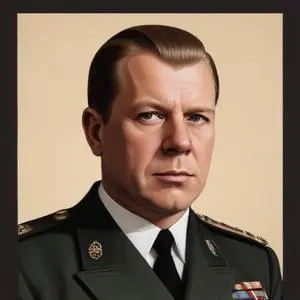
A Norwegian military officer and politician who collaborated with the Nazis during WWII, serving as the Minister President of Norway and implementing fascist policies, earning him infamy as a traitor.
Vidkun Quisling, a Norwegian military officer, politician, and Nazi collaborator, is infamous for heading the government of Norway during the country's occupation by Nazi Germany during World War II. His name has become synonymous with treason and collaboration, earning him a reputation as one of the most reviled figures in Norwegian history.
Born on July 18, 1887, in Fyresdal, Norway, Quisling was raised in a family of modest means. He showed early promise, graduating from the Norwegian Military Academy in 1911. Quisling's military career took him to Russia, where he served as an observer during the Russian Revolution. He later became a close collaborator of the renowned explorer Fridtjof Nansen, participating in humanitarian relief efforts during the Russian famine of 1921.
Quisling's political career began to take shape in the late 1920s, when he served as a minister of defense in the agrarian governments of Peder Kolstad and Jens Hundseid. However, it was his founding of the fascist Nasjonal Samling (National Gathering) in 1933 that marked a significant turning point in his life. Although the party failed to gain significant traction, Quisling's anti-communist and nationalist rhetoric resonated with some Norwegians.
On April 9, 1940, with German forces invading Norway, Quisling seized the opportunity to stage a coup d'état, broadcasting a radio address declaring himself the new prime minister. Although the attempt failed, it marked the beginning of Quisling's collaboration with the Nazi regime.
On February 1, 1942, Quisling formed a new government, approved by the Germans, and served as minister president. His puppet government, dominated by Nasjonal Samling members, participated in Germany's war efforts and deported Jews to concentration camps in occupied Poland. Quisling's regime was marked by brutal suppression of dissent and opposition, earning him the scorn of the Norwegian people.
After the war, Quisling was put on trial during the legal purge in Norway. Found guilty of treason and murder, he was sentenced to death and executed by firing squad on October 24, 1945.
Quisling's name has become a byword for treachery and betrayal. His collaboration with the Nazi regime and role in perpetuating the Holocaust have left an indelible stain on Norway's history. As a symbol of the dangers of fascism and nationalism, Quisling's legacy serves as a cautionary tale for generations to come.
Quisling's collaboration with the Nazi regime is often compared to that of other fascist leaders, such as France's Philippe Pétain and Hungary's Miklós Horthy. While each had their unique circumstances, they share a common thread of betraying their countries and people for personal gain and ideologies.
Quisling's legacy serves as a reminder of the dangers of unchecked nationalism and the importance of protecting human rights and dignity. His story has inspired numerous works of literature, film, and art, ensuring that the lessons of his betrayal are not forgotten.
Born in 1898
A high-ranking Nazi official who served as the Reichskommissar of Norway during World War II, notorious for his brutal rule and war crimes.
Born in 1900
Leading the SS and Gestapo, he oversaw the Nazi regime's brutal security apparatus and implemented the "Final Solution," orchestrating the genocide of six million Jews during World War II.
Born in 1889
The dictator of Nazi Germany, responsible for the genocide of six million Jews and millions of other people during World War II, and infamous for his extreme nationalist and anti-Semitic ideology.
Born in 1893
A German diplomat who served as the Nazi regime's Foreign Minister, orchestrating key alliances and treaties that led to World War II. He was a close associate of Adolf Hitler and played a crucial role in shaping Nazi foreign policy.
Born in 1897
A mastermind of Nazi propaganda, he crafted a persuasive narrative that fueled the Third Reich's rise to power, leaving a lasting impact on the world.
Born in 1893
A high-ranking Nazi official, he was a decorated World War I fighter pilot and later became a prominent politician, serving as Minister President of Prussia. He's infamous for his role in the Nazi regime and war crimes trials.
Born in 1894
A high-ranking Nazi official who flew to Scotland on a solo mission to negotiate peace with the UK, but was instead arrested and imprisoned.
Born in 1903
Austrian-German lawyer and general who served as the highest-ranking leader of the Nazi police forces, responsible for overseeing the Gestapo, SS, and concentration camps during World War II. He was a key figure in the Holocaust and other atrocities committed by the Nazi regime.
