


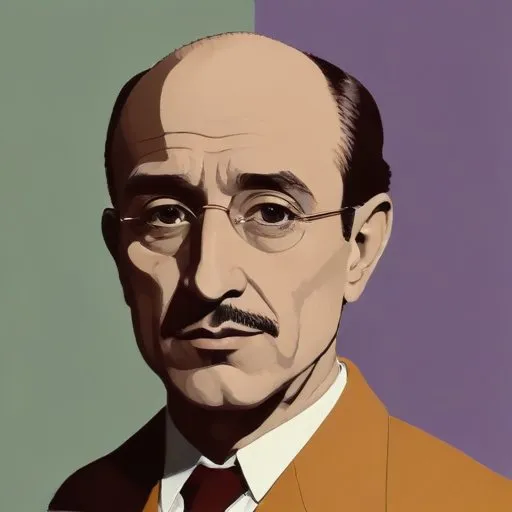
A pioneering figure in American modernism, known for vibrant, expressive portraits and landscapes that blended realism with bold, Fauvist colors.
Walt Kuhn, a pioneering American painter and art organizer, is renowned for curating the groundbreaking Armory Show of 1913, which thrust European Modernism onto the American art scene. This watershed event not only shook the foundations of traditional art forms but also paved the way for a new era of avant-garde expression.
Born on October 27, 1877, in New York City, Kuhn grew up in a working-class family near the Red Hook, Brooklyn docks. His proximity to the waterfront instilled in him a fascination with the rugged, colorful nature of the dockyards, which would later influence his artistic style.
Kuhn's early life was marked by an unorthodox career path, with stints as a bicycle repair shop owner and professional bike racer. However, his innate talent for drawing eventually prevailed, and at 15, he sold his first drawings to a magazine, adopting the signature "Walt" in the process.
In 1893, Kuhn enrolled in art classes at the Brooklyn Polytechnic Institute, nurturing his artistic skills. Six years later, he set off for California with a mere $60 in his pocket, eventually landing a job as an illustrator for WASP Magazine in San Francisco.
Driven by a desire to master his craft, Kuhn embarked on a European odyssey in 1901, studying art at the Académie Colarossi in Paris and later at the Royal Academy in Munich under the tutelage of Heinrich von Zügel, a member of the Barbizon School. This formative experience exposed him to the works of the Old Masters, Impressionists, and Post-Impressionists, irrevocably shaping his artistic perspective.
Upon returning to New York in 1903, Kuhn established himself as a multifaceted artist, working as an illustrator for local journals and exhibiting his work at the Salmagundi Club in 1905. His illustrations for Life magazine, which debuted in 1905, further solidified his reputation as a skilled cartoonist and painter.
In the following years, Kuhn's artistic output continued to flourish, with his work showcasing a unique blend of realism and modernist sensibilities. His paintings, such as "The Vaudeville Act" (1909) and "The Dancer" (1910), captured the essence of urban life, while his illustrations for publications like Life and Harper's Weekly demonstrated his mastery of the medium.
In 1913, Kuhn, along with artist Arthur B. Davies, orchestrated the Armory Show, a revolutionary exhibition that brought European Modernism to American shores. Featuring works by artists like Marcel Duchamp, Henri Matisse, and Pablo Picasso, the show scandalized some but inspired many, paving the way for a new era of artistic innovation.
The Armory Show's impact was profound, influencing a generation of American artists, including the likes of Georgia O'Keeffe, Charles Sheeler, and Stuart Davis. Kuhn's pioneering spirit and organizational prowess had single-handedly reshaped the artistic landscape, ushering in a new era of creative experimentation.
Walt Kuhn's life was marked by a series of personal milestones, including his marriage to Vera Spaulding, a painter in her own right, and his later years, during which he continued to paint and exhibit his work.
Through his tireless efforts as an artist, organizer, and advocate, Kuhn left an indelible mark on the development of American modern art. His legacy extends far beyond the boundaries of his own artistic output, inspiring generations of artists, curators, and art enthusiasts to push the boundaries of creative expression.
Walt Kuhn's remarkable journey, marked by his unwavering passion for art and his unrelenting pursuit of innovation, serves as a testament to the transformative power of creativity and the boundless potential of the human spirit.
Born in 1865
A pioneering figure in American art, known for advocating for a more spontaneous and expressive approach to painting, and for teaching and mentoring many notable artists.
Born in 1867
A pioneering figure in the Ashcan School, known for vivid, gritty depictions of urban life and its struggles. His bold, expressive brushstrokes captured the essence of early 20th-century America.
Born in 1870
American painter and illustrator known for capturing the vibrant spirit of urban life in the early 20th century through his bold, colorful depictions of city streets and everyday people.
Born in 1873
A pioneering figure in American Impressionism, capturing the beauty of urban and natural landscapes with vibrant colors and loose brushstrokes. Known for his dreamy, ethereal depictions of everyday life.
Born in 1858
An American Post-Impressionist painter and art instructor, known for vibrant, expressive depictions of urban leisure activities and landscapes. His work bridges the gap between Impressionism and Fauvism.
Born in 1892
A pioneering American modernist, blending cubism and abstract expressionism to create vibrant, jazz-inspired paintings that explored the intersection of art and everyday life.
