


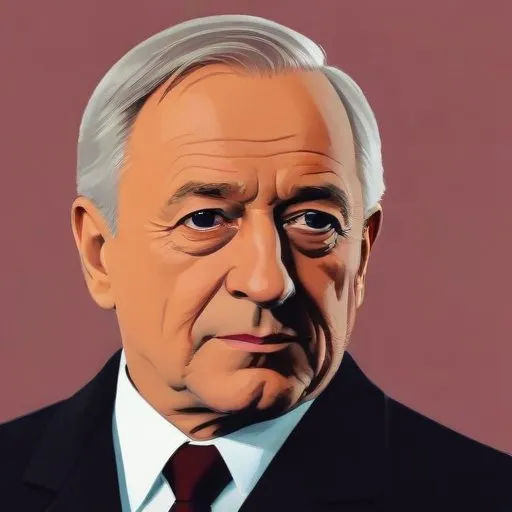
Minister-President of Hesse from 1987 to 1991, known for his conservative politics and efforts to revitalize the German economy.
Walter Wallmann, a German lawyer and politician, left an indelible mark on his country's history through his versatile career, which spanned over three decades. As the Mayor of Frankfurt, Ministerpresident of Hesse, and Federal Minister for Environment, Nature Conservation and Nuclear Safety, he tackled pressing issues, introducing reforms that continue to impact modern Germany.
Wallmann's political journey began in 1966 when he was elected to the Landtag of Hesse from the Christian Democratic Union (CDU) party list. He went on to serve as a member of the Bundestag in 1972 and 1976, before resigning to take on the role of Mayor of Frankfurt in 1977.
As Mayor, Wallmann's leadership brought about a significant shift in Frankfurt's politics. The CDU's victory in the 1977 urban elections ended the Social Democratic Party of Germany's (SPD) dominance, which had lasted since the end of World War II. This change was largely attributed to the SPD's urban policies, known as the Frankfurter Häuserkampf, which led to widespread discontent among the population.
In 1986, Wallmann became the first Federal Minister for Environment, Nature Conservation and Nuclear Safety, a position created in response to the Chernobyl disaster. During his tenure, he introduced crucial regulations, including the amended car tax law to encourage the adoption of low-emission vehicles and the Detergent Act of 1987.
From 1987 to 1991, Wallmann served as the Ministerpresident of Hesse, playing a vital role in shaping the state's politics. Additionally, he held the position of the 39th President of the Bundesrat.
Walter Wallmann's contributions to German politics have had a lasting impact on the country's environment, economy, and social landscape. His dedication to public service and his willingness to address pressing issues have inspired generations of politicians and citizens alike.
Walter Wallmann's remarkable career serves as a testament to the power of vision, determination, and dedication to public service. His legacy continues to influence German politics, inspiring future generations to strive for a better tomorrow.
96 Years Old
The first unified Germany's leader, who oversaw the country's reunification after the Berlin Wall's fall, and is credited with creating a strong, stable economy.
Born in 1915
A prominent post-war German politician who served as Minister President of Bavaria and played a key role in shaping the country's conservative politics. He was also a strong advocate for European integration.
Born in 1904
A German lawyer and politician who served as Chancellor of Germany from 1966 to 1969, known for his role in rebuilding post-war Germany and his efforts to come to terms with the country's Nazi past.
99 Years Old
A German statesman who served as Vice-Chancellor and Foreign Minister, playing a key role in reunifying Germany and shaping European politics. He's known for his diplomatic efforts and advocacy for human rights.
Born in 1918
A German leader who served as Chancellor from 1974 to 1982, known for his pragmatic and socially liberal policies, and his key role in shaping the European Union. He was also a respected economist and published author.
82 Years Old
The 7th Chancellor of Germany, a lawyer-turned-politician, led the country from 1998 to 2005, implementing significant economic and social reforms. He's known for his efforts to modernize Germany and strengthen the European Union.
72 Years Old
The first female Chancellor of Germany, serving for 16 years, known for her leadership during the European sovereign-debt crisis and her role in shaping the European Union's policy. She's a highly influential figure in modern politics.
