


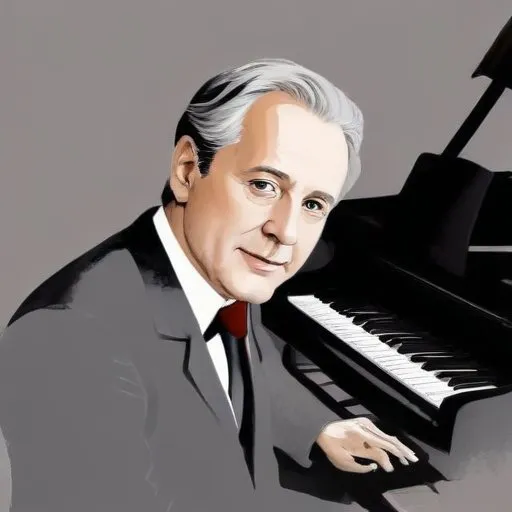
A renowned pianist and composer who blended modernist and neoclassical styles, creating operas and orchestral works that showcased his unique blend of lyricism and complexity.
Werner Egk, a renowned German composer, is best known for his revolutionary radio operas and his significant contribution to the country's musical landscape during the tumultuous 20th century. His innovative works, which blended elements of jazz, dance, and classical music, earned him widespread recognition and acclaim.
Born Werner Joseph Mayer on May 17, 1901, in Auchsesheim, Germany, Egk demonstrated an early talent for music, art, and writing. His family's move to Augsburg when he was six sparked his interest in music, and he went on to study at the municipal conservatory. Egk's creative versatility led him to explore various artistic mediums, including graphic art and writing.
In 1921, Egk married Elizabeth Karl, a violinist, and derived his pen name from her initials, "Egk" being a combination of "Elisabeth, geborne Karl." This unique gesture showcased his love and appreciation for his wife, as well as his ability to think outside the box.
In 1928, Egk moved to Berlin, where he met influential composers Arnold Schoenberg and Hanns Eisler. Recognizing the potential of radio as a mass medium, Egk began to focus on creating operas and radio plays. His friendship with Hans Fleisch, a prominent radio executive, introduced him to the world of broadcasting, and he received his first commission for a radio opera.
Egk's association with musicians Fritz Buchtger, Karl Marx, and Carl Orff, as well as conductor Hermann Scherchen, played a significant role in shaping his compositional style. The influence of Igor Stravinsky's works is evident in Egk's music during this period. His connections with Schott Music in Mainz, a renowned music publisher, further solidified his position in the music world.
The premiere of Egk's radio opera, Columbus, in July 1933, marked a turning point in his career. The work's success led to its staging in April 1934, cementing Egk's reputation as a visionary composer. This breakthrough paved the way for his international recognition, with his music being performed across Europe and beyond.
As the Nazi regime rose to power in 1933, Egk, like many German artists, faced significant challenges. However, he continued to compose, often incorporating subtle critiques of the regime into his works. Despite the difficulties, Egk's music remained popular, and he became a prominent figure in Germany's musical landscape during this tumultuous period.
Born in 1895
A renowned composer and educator, he's famous for his iconic cantata "Carmina Burana", which has become a cultural phenomenon, and his innovative approach to music education.
Born in 1895
A renowned composer, violist, and conductor who blended traditional and modern styles, creating complex yet accessible music that resonated with audiences. His works spanned from operas to chamber music.
Born in 1892
A French composer and educator who blended jazz and classical music to create a unique sound, and is best known for his ballet scores and chamber music compositions.
Born in 1892
A French composer and educator, he blended classical and modern styles, creating iconic works like "Pacific 231" that evoke powerful images and emotions.
Born in 1900
Austrian-American composer and educator who blended jazz and classical music, creating innovative operas and symphonies. Known for his eclectic style and influential teaching methods.
Born in 1900
A renowned pianist and composer who blended jazz and classical music to create iconic scores for Broadway and opera, including "The Threepenny Opera" and "Mahagonny".
Born in 1898
A German-Austrian soldier and composer who wrote music for films, theater, and concert halls, and is best known for his collaborations with Bertolt Brecht and his influence on 20th-century classical music.
Born in 1918
Austrian pianist and composer renowned for his operas and ballets, blending modernist and neoclassical styles, with works like "The Visit of the Old Lady" and "Dantons Tod".
