


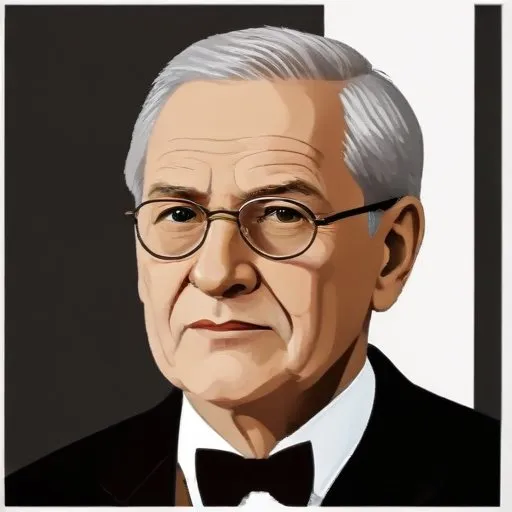
A German physician and academic who performed the first cardiac catheterization on himself, paving the way for modern cardiac surgery and diagnostics.
Werner Forssmann, a German physician and researcher, is renowned for his groundbreaking work in developing the procedure of cardiac catheterization, earning him the Nobel Prize in Medicine in 1956. This pioneering feat revolutionized the field of cardiology, allowing for a minimally invasive way to diagnose and treat heart conditions.
Born on August 29, 1904, in Berlin, Germany, Forssmann's journey in medicine began at the University of Berlin, where he studied medicine and graduated in 1929. His curiosity and passion for improving healthcare led him to hypothesize that a catheter could be inserted directly into the heart, paving the way for his groundbreaking research.
In 1929, Forssmann took a bold step, deciding to test his hypothesis on himself. With the help of Gerda Ditzen, a nurse, he performed the first human cardiac catheterization on himself, risking his own life in the process. Under local anesthesia, he inserted a urinary catheter into his antecubital vein, threading it partly along before releasing Ditzen, who had been unaware of the plan. This daring act of self-experimentation proved that cardiac catheterization was possible, opening doors to a new era in cardiology.
Forssmann's work has had a profound impact on modern medicine, enabling doctors to diagnose and treat heart conditions more effectively and safely. His pioneering spirit and willingness to take risks have inspired generations of medical professionals to push the boundaries of medical research and innovation.
Forssmann's personal life was marked by his dedication to his work and his family. He passed away on June 1, 1979, leaving behind a legacy that continues to inspire and improve healthcare outcomes around the world. His courage, perseverance, and innovative spirit have cemented his place in the annals of medical history.
Werner Forssmann's remarkable story serves as a testament to the power of innovation, courage, and dedication to improving human health. His legacy continues to inspire medical professionals and researchers, pushing the boundaries of what is possible in the field of cardiology.
Born in 1843
A pioneering microbiologist and physician who discovered the bacteria that cause tuberculosis, cholera, and anthrax, revolutionizing the field of microbiology and saving countless lives.
Born in 1852
A German chemist and academic who won the Nobel Prize for synthesizing amino acids and sugars, and establishing the structure of purines, revolutionizing the field of organic chemistry.
Born in 1898
A high-ranking officer in the German Wehrmacht during World War II, known for his involvement in the July 20 plot to assassinate Adolf Hitler.
Born in 1900
German physician and biochemist who discovered the citric acid cycle, a crucial process by which cells generate energy from food, revolutionizing our understanding of cellular metabolism.
Born in 1905
A pioneering biochemist who discovered the mechanism of RNA synthesis, earning a Nobel Prize in Physiology or Medicine in 1959. His work laid the foundation for our understanding of genetic code and protein synthesis.
Born in 1918
Pioneering biochemist who discovered the mechanism of DNA replication and was awarded the Nobel Prize in Physiology or Medicine in 1959 for his groundbreaking work on nucleic acid synthesis.
