


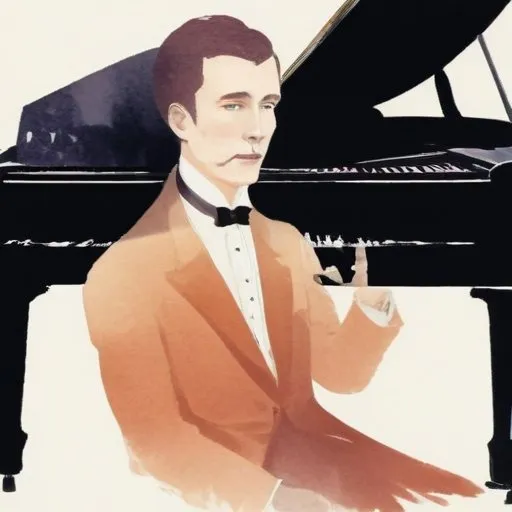
A talented pianist and composer, known for his romantic and expressive works, particularly his piano quintet and chamber music.
William Yeates Hurlstone was a British composer whose life was as fleeting as it was phenomenal. Despite his early demise, he left behind an exquisite, albeit small, body of work that has captivated the hearts of music enthusiasts for generations.
Born on 7 January 1876, in Fulham, London, Hurlstone was the only son of Martin de Galway Hurlstone, a surgeon, and Maria Bessy Styche, a piano teacher. His maternal grandfather, Frederick Yeates Hurlstone, was the president of the Royal Society of British Artists, a testament to the artistic inclinations that ran deep in the family.
Hurlstone's earliest musical education was under the tutelage of his mother, who instilled in him a love for music. By the age of nine, he was composing piano pieces that were deemed polished enough to be published. This exceptional talent did not go unnoticed, and at 18, he won a scholarship to study piano and composition at the prestigious Royal College of Music.
At the Royal College, Hurlstone was fortunate to be mentored by Sir Charles Villiers Stanford, who considered him the most talented of his pupils, above the likes of Ralph Vaughan Williams and Gustav Holst. His piano professors included Algernon Ashton and Edward Dannreuther, who further honed his skills.
Hurlstone's oeuvre, though limited in quantity, is a testament to his genius. His compositions include a Trio for Clarinet, Bassoon, and Piano, which won him the scholarship to the Royal College of Music, as well as numerous piano pieces, songs, and chamber music. His legacy is a poignant reminder of the potential that was lost, but his music continues to inspire and delight audiences.
Hurlstone's life was tragically cut short when he succumbed to illness on 30 May 1906, at the tender age of 30. His untimely death was a devastating loss to the music world, but his contributions continue to be celebrated and cherished.
Hurlstone's music serves as a testament to the power of talent, dedication, and passion. His legacy inspires generations of musicians and composers to strive for excellence, and his compositions remain a source of beauty and joy for those who have had the privilege of experiencing them.
Though his life was short, William Hurlstone's impact on the world of music will be felt for generations to come. His story is a poignant reminder that talent knows no bounds, and that even the briefest of lives can leave an indelible mark on the world.
Born in 1872
A renowned composer and educator, he's celebrated for his symphonies and folk-song inspired works that evoke a sense of English heritage and nostalgia. His music is a testament to his love for his homeland's cultural roots.
Born in 1874
A renowned composer and educator, best known for his orchestral suite "The Planets", which evokes a sense of cosmic wonder and exploration. His music is a staple of classical repertoire, still widely performed today.
Born in 1862
A pioneering composer of the early 20th century, known for his impressionistic and expressive works that evoke a sense of nature and the human experience. His music is characterized by lush harmonies and orchestration.
Born in 1857
A renowned composer and educator, best known for his iconic orchestral works, including the majestic "Pomp and Circumstance" march, which is a staple at graduations worldwide.
Born in 1848
A renowned composer and music historian, he's credited with elevating British music to international prominence, particularly through his iconic "Jerusalem" anthem.
Born in 1852
A renowned Irish composer, conductor, and educator who made significant contributions to the development of classical music, particularly in the UK and Ireland, and is remembered for his iconic choral works and operas.
Born in 1914
A prolific actor and director, known for his rugged, versatile performances in film and television, often playing cowboys and authority figures.
Born in 1883
A celebrated composer and poet, he crafted symphonies, concertos, and tone poems that showcased his mastery of orchestration and poetic flair. His works evoke a sense of mysticism and Celtic mythology.
