


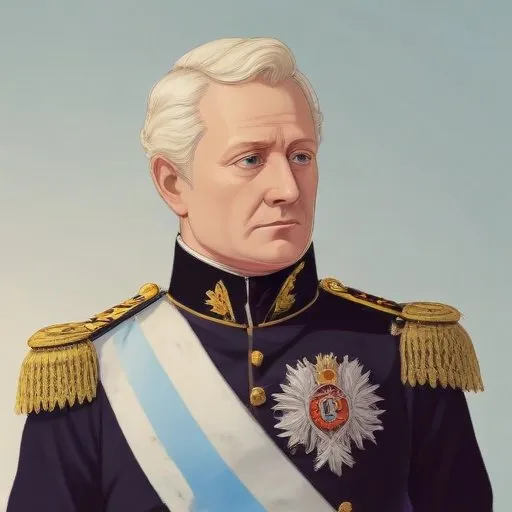
Ruler of Bavaria from 1508 to 1550, known for promoting Renaissance culture, arts, and architecture, and issuing the Reinheitsgebot, a famous beer purity law.
William IV, Duke of Bavaria, is best known for his pioneering work in brewing, issuing the famous Reinheitsgebot, or German Beer Purity Law, in 1516, which remains the cornerstone of German brewing tradition to this day. However, his impact extends far beyond the realm of beer, as he played a significant role in shaping Bavarian politics, culture, and society during his 42-year reign as Duke of Bavaria from 1508 to 1550.
Born on November 13, 1493, in Munich, William was the son of Albert IV, Duke of Bavaria, and Kunigunde of Austria, daughter of Emperor Frederick III. His family's strong connections to the Habsburgs and the Holy Roman Empire would influence his future political endeavors.
William's reign was marked by a complex web of alliances and conflicts with the Habsburgs, the Holy Roman Empire, and the emerging Protestant Reformation. Initially sympathetic to Martin Luther's ideas, William later banned the promulgation of Luther's works in 1522, fearing the Reformation's growing popularity in Bavaria. He became a key figure in the German Counter-Reformation, working closely with Pope Clement VII to counter the spread of Protestantism.
In 1534, William reached an agreement with Ferdinand I in Linz, ending his conflict with the Habsburgs. He then supported Charles V in his war against the Schmalkaldic League in 1546, although he failed to preserve the Palatine electoral dignity.
On April 23, 1516, William issued his famous purity regulation for Bavarian beer, stating that only barley, hops, and water could be used in brewing. This decree, known as the Reinheitsgebot, remained in force for over 470 years, until it was abolished as a binding obligation in 1986. This pioneering work in brewing regulation cemented Bavaria's reputation as a hub for high-quality beer production.
William IV's reign marked a significant turning point in Bavarian history, shaping the region's politics, culture, and society for centuries to come. His commitment to the Counter-Reformation and his role in shaping the German brewing tradition have left an enduring legacy.
In addition to his beer purity law, William's cultural contributions extend to his patronage of the arts and his efforts to promote education in Bavaria. He supported the University of Ingolstadt, founded in 1472, and encouraged the development of humanist scholarship in the region.
William's personal life was marked by a strong sense of duty and a commitment to his family's legacy. He was known for his close relationship with his brother, Louis X, with whom he ruled Bavaria until 1545. His chancellor, Leonhard von Eck, played a significant role in shaping his policies and decisions throughout his reign.
Despite his many achievements, William's life was not without controversy. He faced opposition from the Protestant states and struggled to balance his loyalty to the Habsburgs with his commitment to Bavarian autonomy.
William IV, Duke of Bavaria, left an indelible mark on German history, shaping the country's politics, culture, and society for generations to come. His pioneering work in brewing regulation and his commitment to the Counter-Reformation have cemented his legacy as one of the most important figures in Bavarian history.
Born in 1417
A powerful and ambitious ruler who expanded Bavaria's territory and influence through strategic marriages and military campaigns, earning him the nickname "the Rich".
Born in 1528
A 16th-century German nobleman who ruled Bavaria and was a key figure in the Counter-Reformation, known for his strong Catholic stance and patronage of the arts.
Born in 1417
A powerful and ambitious ruler who expanded Bavaria's territory and influence through strategic marriages and military campaigns, earning him the nickname "the Rich".
Born in 1548
A 16th-century German ruler who governed Bavaria during a time of significant cultural and religious change, and is remembered for his role in the Counter-Reformation.
Born in 1584
Ruler of Bavaria from 1669 to 1679, known for his attempts to centralize power and reform the government. He also supported the arts and architecture, commissioning several notable buildings.
Born in 1710
The monarch who ruled France from 1715 to 1774, known as the "Sun King's" great-grandson, and remembered for his extravagance, absolutism, and the decline of the French monarchy.
Born in 1500
Ruling over a vast empire from 1519 to 1556, he was a powerful and influential leader who played a crucial role in shaping European politics and religion. He is most known for his efforts to unify Christian Europe and defend it against the Ottoman Empire.
Born in 1503
The first Habsburg to rule the Holy Roman Empire, he unified Austria and introduced the concept of a hereditary monarchy, shaping European politics for centuries to come.
