


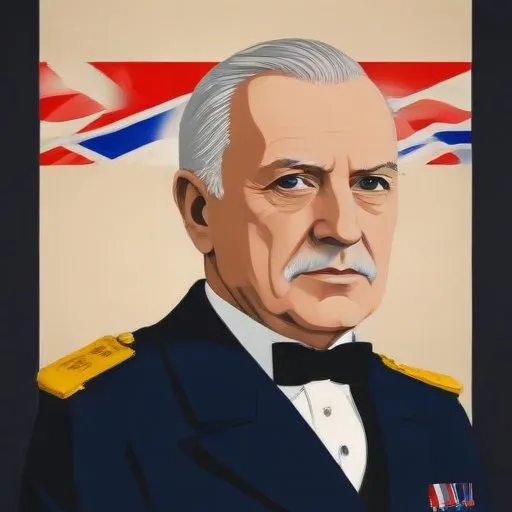
A British army officer and engineer who served as the Governor of South Australia, known for his role in shaping the colony's infrastructure and defense. He designed and built several forts, including Fort Glanville, and played a key role in the development of Adelaide's early infrastructure.
William Jervois, a prominent figure in British military and diplomatic circles, is renowned for his remarkable governorships of the Straits Settlements, South Australia, and New Zealand, as well as his pioneering work in fortification design and military engineering.
Born on September 10, 1821, in Cowes, Isle of Wight, Jervois hailed from a military family of Huguenot descent. His father, General William Jervois, was a respected military officer, and his mother, Elizabeth Jervois (née Maitland), instilled in him the values of discipline and hard work. Jervois received his early education at Dr. Burney's Academy, Gosport, before entering the Royal Military Academy, Woolwich, where he honed his skills in science, mathematics, and engineering.
Commissioned as a second lieutenant in the Royal Engineers in March 1839, Jervois underwent rigorous training at the School of Military Engineering at Chatham. In 1842, he was posted to South Africa, where he saw action in the 7th Xhosa War and sketched the British Kaffraria region. His military acumen and artistic talent earned him recognition, and he was promoted to lieutenant in 1841.
In 1848, Jervois returned to Britain and commanded a company of Sappers and Miners at Woolwich. He was subsequently tasked with overseeing the construction of substantial fortifications in Alderney, a project that caught the attention of Queen Victoria and Prince Albert. Impressed by his work, they promoted him to the rank of major in 1854.
Jervois's exceptional military and engineering expertise led to his appointment as Secretary of a Royal Commission in 1858, which examined the state and efficiency of British land-based fortifications against naval attack. This experience prepared him for his subsequent governorships, where he applied his knowledge of fortification design and military strategy to ensure the security and development of the territories under his administration.
From 1875 to 1888, Jervois served as Governor of the Straits Settlements, South Australia, and New Zealand, respectively. During his tenure, he implemented numerous infrastructure projects, fostered economic growth, and maintained peaceful relations with neighboring nations.
William Jervois left an indelible mark on the territories he governed and the world of military engineering. His innovative approaches to fortification design and his dedication to the development of the regions under his care have inspired generations of military officers, engineers, and diplomats.
Today, William Jervois is remembered as a visionary leader, a skilled military engineer, and a dedicated diplomat who left a lasting impact on the territories he governed and the world at large.
Born in 1833
A British army officer who led military campaigns in Africa and China, and later became the governor of Sudan, known for his bravery and heroism during the Siege of Khartoum.
Born in 1815
A pioneering figure in Australian politics, instrumental in shaping the country's federation and unity, known for his tireless advocacy for a unified Australia.
Born in 1856
The 2nd Prime Minister of Australia, a key figure in the country's early development, known for his role in shaping Australia's constitution and federation. He played a crucial part in uniting the country's six colonies into a single nation.
Born in 1849
Australia's first Prime Minister, who played a key role in the country's federation and shaped its early government, is most known for uniting the country's six colonies into one nation. He was a strong advocate for Australian independence and self-governance.
Born in 1845
The 4th Prime Minister of Australia, a Scottish-Australian lawyer and politician who served from 1904 to 1905, known for his role in shaping the country's early years and contributing to its growth.
Born in 1867
Third Prime Minister of Australia, serving from 1904 to 1905, known for his efforts to establish a national government and implement progressive reforms.
Born in 1862
The 5th Prime Minister of Australia, a key figure in the country's early 20th-century politics, known for his role in shaping Australia's social and economic landscape. He played a crucial part in establishing the country's old-age pension and maternity allowance systems.
Born in 1860
The 6th Prime Minister of Australia, a key figure in the country's early 20th-century politics, known for his role in shaping Australia's economy and foreign policy. He played a crucial part in Australia's transition from a British colony to an independent nation.
