


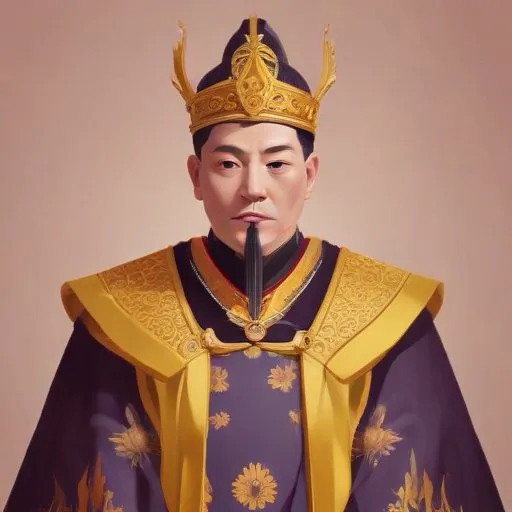
The Mongol khan who ruled China during the Yuan dynasty, known for his military campaigns and administrative reforms that shaped the empire's governance and economy.
Yesn Temr, also known as the Taiding Emperor of Yuan China, was a great-grandson of Kublai Khan and an emperor of the Yuan dynasty of China from 1323 to 1328. He is revered for his efforts to revive the traditional ways of the Mongols, earning him a special place in Chinese historiography.
Yesn Temr was born in Mongolia in 1293 to Gammala, the eldest son of Zhenjin, who was presumed heir to his father Kublai Khan. Despite being born into a royal family, Yesn Temr's path to the throne was not straightforward. His father Gammala was appointed as Jinong jinwang in 1292, but he lost the race for successor to his younger brother Temr.
After Gammala's death in 1302, Yesn Temr took over as Jinong and ruled the Mongolian steppe north of the Gobi Desert. During the reigns of Kulug Khan, Ayurbarwada, and Gegeen Khan, Yesn Temr emerged as one of the most respected princes in the steppe, known for his large fief and powerful army.
In 1323, Shidebala Gegeen Khan, also known as Emperor Yingzong, was assassinated by Grand Censor Tegshi and Esen Temur. The rebellious group welcomed Yesn Temr as the new emperor, largely due to his mother's connection to the Khunggirad clan.
Yesn Temr cleverly caused Tegshi's envoy Walus to be seized and sent notice of the plot to Shidebala Khan, ultimately securing his place on the throne. This strategic move marked the beginning of his reign as the 10th Khagan of the Mongol Empire, although it was only nominal due to the division of the empire.
Yesn Temr's reign is notable for his attempts to revive the traditional ways of the Mongols. He was known for his fondness of Mongolian customs and was said to have been visited by the Franciscan friar Odoric, who left a detailed record of his travels.
Although his reign was marked by controversy and rebellion, Yesn Temr's efforts to restore Mongolian traditions have earned him a special place in Chinese historiography. He is remembered as a leader who respected the nomadic lifestyle and cultural heritage of the Mongols.
Yesn Temr's legacy extends beyond the Mongol Empire, influencing the cultural and historical context of modern China. His attempts to revive traditional Mongolian ways have inspired future generations to appreciate and respect their cultural heritage.
Today, Yesn Temr is remembered as a leader who sought to preserve the Mongolian identity, making him an important figure in Chinese history and beyond.
| Year | Event |
|---|---|
| 1293 | Born in Mongolia |
| 1302 | Took over as Jinong |
| 1323 | Became the 10th Khagan of the Mongol Empire |
| 1328 | Died on August 15 |
Yesn Temr's remarkable journey from prince to emperor is a testament to his strength, strategic thinking, and dedication to preserving Mongolian traditions. His legacy continues to inspire and educate people around the world.
Born in 1592
The second founder of the Qing dynasty, who unified various Mongol and Manchu tribes, and expanded the empire's borders through successful military campaigns. He is also known for creating a new administrative system and promoting Confucianism.
Born in 1612
A powerful Chinese prince and regent who played a crucial role in establishing the Qing dynasty and shaping China's history. He's known for his military campaigns and effective governance.
Born in 1638
The first Qing dynasty emperor to rule from Beijing, he oversaw the transition from nomadic tribal leader to imperial ruler, establishing a strong foundation for the Qing dynasty.
Born in 1678
The fourth emperor of the Qing dynasty, who ruled China from 1722 to 1735, is known for his efficient administration, economic reforms, and military campaigns that expanded the empire's borders. He's also famous for his mysterious death, with rumors of assassination or poisoning.
Born in 1711
Ruling China from 1735 to 1796, this emperor oversaw a golden age of prosperity, territorial expansion, and cultural achievements, leaving a lasting legacy in Chinese history.
Born in 1507
Ruling China from 1521 to 1566, this emperor oversaw a period of cultural and economic growth, while also being known for his tyrannical behavior and persecution of officials.
