


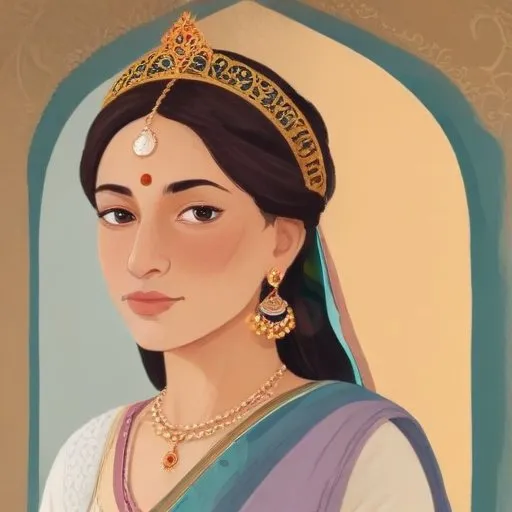
Mughal princess and poet who wrote passionate and introspective verses, often expressing her longing for freedom and autonomy. Her poetry is celebrated for its lyricism and emotional depth.
ZebunNissa, born on February 15, 1638, was a renowned Mughal princess, poet, and intellectual, remembered for her exceptional literary talents and her tumultuous life under the shadow of her famous father, Emperor Aurangzeb. Her poetic works, written under the pseudonym Makhfi, meaning "Hidden" or "Concealed One," continue to captivate readers with their profound insights and intricate craftsmanship.
ZebunNissa was the eldest child of Emperor Aurangzeb and his chief consort, Dilras Banu Begum, a princess of the prominent Safavid dynasty. Born in Daulatabad, Deccan, she was her father's favorite daughter, and her intellect and literary inclinations earned her a privileged position in the royal court. Under the guidance of Hafiza Mariam, a distinguished lady-in-waiting, ZebunNissa memorized the Quran at the tender age of seven and was rewarded with 30,000 gold pieces by her delighted father.
ZebunNissa's exceptional abilities were nurtured by her father, who recognized her potential and encouraged her intellectual pursuits. She was tutored by Mohammad Saeed Ashraf Mazandarani, a celebrated Persian poet and scholar, who instilled in her a deep understanding of philosophy, mathematics, astronomy, and literature. This education laid the foundation for her future poetic endeavors and intellectual contributions.
ZebunNissa's poetic works, written primarily in Persian, showcased her mastery of language and her deep understanding of human emotions. Her poetry, characterized by its lyricism, sensuality, and introspection, explored themes of love, spirituality, and existential crisis. The Diwani Makhfi, her collected works, is a testament to her literary genius and continues to be celebrated as a landmark of Mughal literature.
Despite her intellectual and artistic accomplishments, ZebunNissa's life took a dramatic turn when she was imprisoned by her father in Salimgarh Fort, Delhi, around 1680. The exact reasons for her imprisonment remain shrouded in mystery, but it is believed that her independent nature and intellectual pursuits were perceived as a threat to her father's authority. Despite this confinement, ZebunNissa continued to write, and her poetry reflects the depth of her emotions and the anguish of her captivity.
ZebunNissa's life and works have left an indelible mark on Indian literature and cultural heritage. Her poetry, infused with philosophical and spiritual themes, has inspired generations of writers and thinkers. Her legacy extends beyond literature, serving as a testament to the intellectual and artistic achievements of Mughal women, who played a significant role in shaping the cultural landscape of their time.
ZebunNissa's poetry and writings reveal a deep understanding of Sufi philosophy and mysticism. Her works are infused with a sense of spiritual ecstasy and a quest for union with the Divine. Her poetry also reflects her fascination with the mysteries of life, death, and the human condition, demonstrating her intellectual curiosity and philosophical inclinations.
ZebunNissa's remarkable story, marked by both triumph and tragedy, continues to captivate readers and inspire writers. Her literary legacy, philosophical contributions, and personal achievements serve as a testament to the enduring power of human creativity and intellectual curiosity.
"My heart is aflame with love, My soul is in pursuit of the beloved. In the mirror of existence, I see the reflection of the One."
This quote, taken from her poetry, exemplifies her spiritual and philosophical inclinations, echoing the Sufi and mystical themes that permeate her works.
Born in 1593
The beloved wife of Mughal Emperor Shah Jahan, buried in the stunning white marble mausoleum she inspired, a testament to eternal love and architectural innovation.
Born in 1614
Mughal Empire's eldest daughter, a poet, and a patron of the arts, known for her literary works and architectural contributions, including the design of Chandni Chowk in Delhi.
Born in 1615
The eldest son of Mughal Emperor Shah Jahan, a philosopher and translator who sought to find common ground between Islam and Hinduism, and translated many Hindu texts into Persian. He was a symbol of religious tolerance and harmony in 17th-century India.
Born in 1618
The Mughal emperor who ruled India from 1658 to 1707, expanding the empire to its greatest extent and implementing Islamic law, while also being known for his architectural achievements, including the Badshahi Mosque.
Born in 1592
The fifth Mughal emperor, who built the iconic Taj Mahal as a mausoleum for his beloved wife, and expanded the empire through military campaigns and architectural achievements.
Born in 1643
The seventh Mughal emperor, who ruled India from 1707 to 1712, is known for his military campaigns and efforts to consolidate the empire's territories. He's also famous for his poetry and patronage of the arts.
