


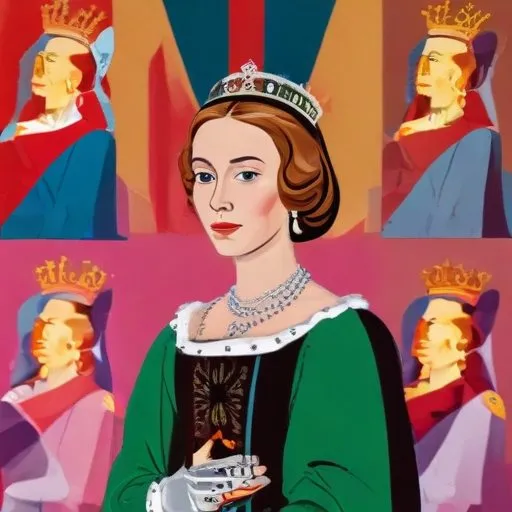
Wife of King Sigismund III Vasa, she played a significant role in Polish politics and was a patron of the arts. She's remembered for her cultural achievements and strong will.
Anne of Austria, born on August 16, 1573, was the revered Queen of Poland and Sweden, distinguishing herself as the devoted wife of King Sigismund III Vasa and a pillar of Catholicism. As the first consort of the Polish monarch, she left an indelible mark on the history of Poland, solidifying her position as a champion of the Counter-Reformation.
Born into the esteemed House of Habsburg, Anne was the daughter of Charles II of Austria and Maria Anna of Bavaria. Her mother, a fervent supporter of the Counter-Reformation, instilled in Anne a deep devotion to Catholicism, which would shape her life and reign. From a tender age, Anne was immersed in the teachings of the Church, attending church services from the age of one, and learning Latin as a priority over her native German language.
Under the guidance of Catholic priests, Anne was educated in the ways of the faith, and her mother ensured that she developed skills in household tasks such as sewing and cooking. This well-rounded upbringing prepared Anne for her future role as a queen, where she would be expected to exemplify the virtues of her faith.
In 1577, the Papal envoy to Sweden, Antonio Possevino, proposed a marriage alliance between the Habsburgs and Sweden, with Anne being considered as a potential bride for King John III of Sweden's son, Sigismund. Although the plan was initially met with approval, it was soon superseded by a proposal to marry Anne to Henry of Lorraine, aimed at preventing French expansion in Lorraine.
However, fate had other plans, and in 1586-1587, Anne accompanied her parents to the Imperial court in Vienna and Prague, where she unofficially explored the possibility of marrying her cousin Emperor Rudolf II. Ultimately, it was her union with Sigismund III Vasa that would seal her place in history as the Queen of Poland.
As Queen of Poland, Anne remained steadfast in her devotion to Catholicism, using her position to promote the Counter-Reformation in Poland. Her reign was marked by her efforts to strengthen the bonds between Poland and the Habsburgs, as well as her support for the Jesuit order.
Anne's legacy extends beyond her role as a queen, as she played a crucial part in shaping the cultural and religious landscape of Poland. Her commitment to her faith and her people has left an enduring impact on Polish history, earning her a revered place among the annals of Polish royalty.
In conclusion, Anne of Austria, Queen of Poland, was a woman of unyielding faith and devotion, whose life was a testament to the power of conviction and dedication. Her reign continues to inspire generations, serving as a beacon of hope and perseverance in the face of adversity.
Born in 1545
Daughter of King Henry II of France, she was a queen of Spain through her marriage to Philip II, playing a crucial role in 16th-century European politics and diplomacy.
Born in 1553
The Queen of France who brokered peace between Catholics and Protestants through her marriage, but her lavish lifestyle and scandals sparked the St. Bartholomew's Day massacre.
Born in 1519
King of France from 1547 to 1559, known for his cultural and artistic patronage, and his role in the Italian Wars.
Born in 1575
The Queen of France who commissioned the Luxembourg Palace and was the subject of Peter Paul Rubens' famous cycle of paintings, known for her extravagant lifestyle and political influence.
Born in 1785
The last king of the French monarchy before the French Revolution, known for his tragic and mysterious life, including his imprisonment and disputed death.
Born in 1585
A powerful and cunning statesman who dominated French politics during the 17th century, known for his ruthless suppression of dissent and centralization of power. He was a master strategist and diplomat who shaped the course of European history.
