


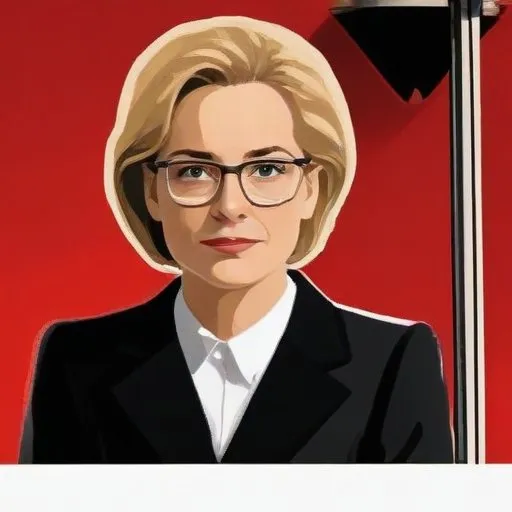
A German politician, lawyer, and civil law notary who advocated for women's rights and social justice, particularly in the fields of family and inheritance law.
Known for her unwavering dedication to public service and her impressive legal expertise, Barbara SaViehweger is a respected German politician and civil law notary who has left an indelible mark on her country's legal and political landscape. With a career spanning over four decades, SaViehweger has been a champion of justice, equality, and human rights, making her a household name in Germany and beyond.
Born on August 4, 1943, in Worbis, Province of Saxony, Barbara SaViehweger grew up in Berlin, where she attended school and later pursued her higher education. She studied jurisprudence in Berlin, Kln, and Freiburg, passing her Second Staatsexamen in 1970. This academic achievement laid the foundation for her future success as a lawyer and politician.
SaViehweger's political career began in 1971 when she was elected to the communal parliament in Steglitz, a position she held until 1975. Her dedication and passion for public service soon led her to the Abgeordnetenhaus of Berlin, where she served as a member from 1975 to 1995. During this period, she was re-elected six times, earning a direct mandate from her electoral district each time.
As a member of the Christian Democratic Union of Germany (CDU), SaViehweger played a crucial role in shaping the country's legal and domestic policies. She served as the speaker of the parliamentary group of the CDU for many years, focusing on legal and domestic policy. Her expertise was further demonstrated through her participation in several investigation committees and her chairmanship of the Enquete-Kommission inquiry commission for the administration reform in Berlin.
SaViehweger's commitment to social justice, equality, and human rights is deeply rooted in her Catholic faith. Her involvement with the Roman Catholic parish Mater Dolorosa Berlin-Lankwitz, where she serves as a member of the management board and the council of the independent foundation Stiftung Mater Dolorosa Berlin-Lankwitz, reflects her compassion for the underprivileged and her dedication to creating a more just society.
Throughout her illustrious career, SaViehweger has received numerous awards and honors for her outstanding contributions to law, politics, and society. Her tireless efforts to promote justice, equality, and human rights have earned her recognition and respect from her peers, colleagues, and the general public.
As a trailblazing politician and civil law notary, Barbara SaViehweger has left an indelible mark on Germany's legal and political landscape. Her unwavering commitment to justice, equality, and human rights has inspired generations of lawyers, politicians, and social activists. Her legacy serves as a testament to the power of dedication, hard work, and compassion, inspiring us all to strive for a more just and equitable society.
72 Years Old
The first female Chancellor of Germany, serving for 16 years, known for her leadership during the European sovereign-debt crisis and her role in shaping the European Union's policy. She's a highly influential figure in modern politics.
82 Years Old
The 7th Chancellor of Germany, a lawyer-turned-politician, led the country from 1998 to 2005, implementing significant economic and social reforms. He's known for his efforts to modernize Germany and strengthen the European Union.
96 Years Old
The first unified Germany's leader, who oversaw the country's reunification after the Berlin Wall's fall, and is credited with creating a strong, stable economy.
Born in 1915
A prominent post-war German politician who served as Minister President of Bavaria and played a key role in shaping the country's conservative politics. He was also a strong advocate for European integration.
99 Years Old
A German statesman who served as Vice-Chancellor and Foreign Minister, playing a key role in reunifying Germany and shaping European politics. He's known for his diplomatic efforts and advocacy for human rights.
Born in 1919
A German politician who served as President of West Germany from 1974 to 1979, known for his efforts to improve relations with East Germany and his role in shaping the country's foreign policy.
Born in 1914
A German military officer turned politician who served as the President of West Germany from 1979 to 1984, known for his conservative policies and efforts to strengthen the country's economy. He played a key role in shaping Germany's post-war identity and foreign policy.
Born in 1920
A German politician who served as President of Germany from 1984 to 1994, known for his efforts to come to terms with Germany's Nazi past and promote European integration.
