


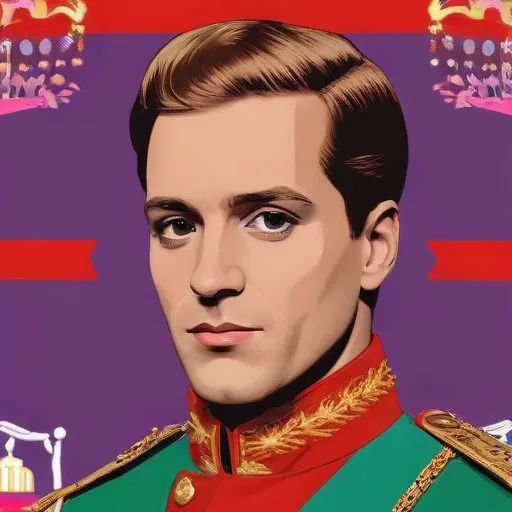
A German prince who ruled Anhalt-Zerbst and was the father of Catherine the Great, the famous Empress of Russia. He played a significant role in shaping European history through his daughter's reign.
Christian August, Prince of Anhalt-Zerbst, was a German prince of the House of Ascania, and most notably, the father of Catherine the Great, the legendary Empress of Russia. As a ruler of the Principality of Anhalt-Zerbst, he played a significant role in shaping the course of European history, leaving behind a lasting legacy that still resonates today.
Christian August was born on November 29, 1690, in Dornburg, Germany. From a young age, he was drawn to a life of military service, and in 1708, he joined the Regiment on foot in Anhalt-Zerbst No. 8, which later became the Grenadiers Regiment King Frederick William IV of Prussia. He quickly rose through the ranks, earning numerous promotions and accolades, including the Order De la Gnrosit (later renamed Pour le Mérite) in 1711.
Throughout his military career, Christian August took part in several campaigns during the Spanish War of Succession and in the Netherlands, showcasing his bravery and strategic prowess. His rapid ascent continued, with appointments as Chief of the Regiment in 1716, Colonel in 1721, and Major-General in 1725.
In 1729, Christian August became Commander of Stettin, a position that cemented his reputation as a skilled military leader. On May 28, 1732, he was designated Lieutenant-General, and in 1741, he achieved the highest military dignity, the rank of Generalfeldmarschall, bestowed upon him by King Frederick II of Prussia.
In the same year, the death of his cousin, John Augustus, Prince of Anhalt-Zerbst, without an heir, led to Christian August inheriting the entire Principality of Anhalt-Zerbst. This marked the beginning of his rule, which would last until his death in 1747.
Christian August's most enduring legacy, however, lies in his role as the father of Catherine the Great, one of the most influential women in Russian history. Born Sophia Dorothea of Anhalt-Zerbst, Catherine would go on to rule Russia from 1762 to 1796, leaving an indelible mark on the country's politics, culture, and architecture.
Despite his own significant achievements, Christian August's life was often overshadowed by the towering figure of his daughter. Nevertheless, his influence on Catherine's early life and upbringing cannot be overstated, and his legacy continues to be felt through her remarkable achievements.
Christian August, Prince of Anhalt-Zerbst, died on March 16, 1747, in Zerbst, Germany, leaving behind a rich cultural and historical heritage. His life's work, marked by military distinction, wise governance, and paternal pride, continues to inspire and fascinate historians and enthusiasts alike.
Through his daughter, Catherine the Great, Christian August's impact on Russian history and culture remains profound, a testament to the enduring power of family, legacy, and the bonds that shape our collective human experience.
Born in 1729
Empress of Russia from 1762 to 1796, she transformed her country into a major European power, modernizing its culture, politics, and economy through numerous reforms and conquests.
Born in 1712
Prussian king who ruled with Enlightenment values, promoting arts, education, and religious tolerance, while also being a skilled military strategist and expanding his kingdom through wars.
Born in 1672
Reformed Russia's government, military, and culture, transforming it into a major European power. Known for modernizing and westernizing the country through numerous reforms and founding St. Petersburg.
Born in 1717
The wife of Francis I, Holy Roman Emperor, ruled Austria and its territories with intelligence and diplomacy, implementing reforms and expanding the empire through strategic marriages. She's remembered for her strong leadership and cultural achievements.
Born in 1741
Reformer of the Habsburg dominions, abolishing serfdom and promoting religious tolerance, who implemented numerous reforms to modernize his empire.
Born in 1747
The last Habsburg ruler to hold the title of Holy Roman Emperor, he oversaw the dissolution of the empire and played a key role in European politics during the French Revolution.
Born in 1768
The last Holy Roman Emperor, who ruled from 1792 to 1806, oversaw the dissolution of the Holy Roman Empire and was a key figure in European politics during the Napoleonic Wars.
Born in 1769
A French military leader who rose to prominence during the French Revolution and became Emperor of France, known for his military conquests and reorganization of Europe. He is also famous for his Napoleonic Code, which remains a foundation of modern law.
