


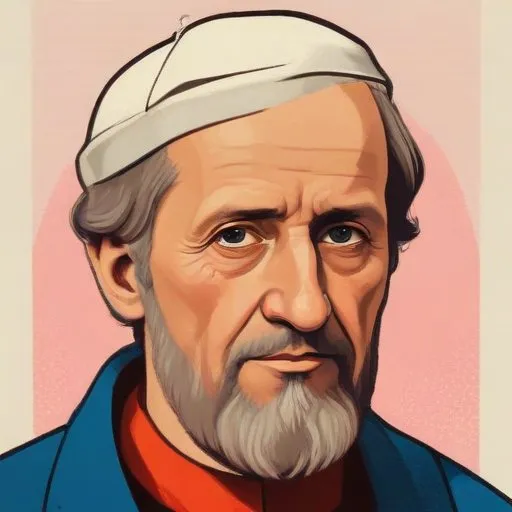
A 16th-century German philologist who pioneered the study of ancient languages, particularly Greek and Hebrew, and wrote influential works on biblical scholarship.
Junius was born on January 29, 1591, in Heidelberg, Germany. His father, Franciscus Junius, was a professor of Hebrew at Leiden University, and Junius's early life was shaped by his father's academic pursuits. After his parents' demise in 1602, Junius moved to Dordrecht to live with his future brother-in-law, the humanist scholar Gerhard Johann Vossius.
Junius's initial interest in military studies gave way to theological pursuits after the peace treaty between Spain and the Netherlands in 1609. He went on to study theology at Leiden and Middelburg. However, his ministerial career was short-lived, as he resigned from his pastorship at Hillegersberg in 1618 due to his refusal to take sides in a theological conflict within the Dutch Reformed Church.
Junius's travels took him to France and eventually to England, where he became employed by Thomas Howard, the Earl of Arundel, as a tutor to his son and later as librarian. It was during this period that Junius wrote De pictura veterum, a seminal work that theoretical discussion of classical art, which would go on to become a cornerstone of the Neoclassical movement.
Published in 1637 in Latin, De pictura veterum was followed by Junius's own translations into English (1638) and Dutch (1641). The latter edition was specifically written with artists in mind, showcasing Junius's commitment to making his work accessible to a broader audience.
Junius's work has had a lasting impact on the field of Germanic philology, and his influence can be seen in the development of classical art theories throughout Europe. His dedication to collecting and publishing ancient manuscripts has left a rich legacy, making him a pioneer in his field.
Franciscus Junius's remarkable life and work have left an indelible mark on the world of Germanic philology, and his legacy continues to inspire scholars and artists alike.
Born in 1560
A Dutch theologian who challenged Calvinist teachings, advocating for free will and conditional election, and is considered the father of Arminianism. His views shaped Protestant theology and sparked intense debates.
Born in 1583
A 17th-century philosopher and jurist who laid the foundations for modern international law, particularly the concept of "just war" and the laws of the sea.
Born in 1583
A Dutch theologian and academic who played a key role in the Remonstrant movement, advocating for Arminian theology and influencing the development of Protestantism. He's also known for his debates with Calvinist theologians.
Born in 1569
A 17th-century Dutch theologian who challenged traditional Calvinist views, sparking controversy and debate among European scholars. He's most known for his unorthodox ideas on God's nature and human free will.
Born in 1633
The last Catholic monarch of England, Scotland, and Ireland, who attempted to restore Catholicism and absolute monarchy, sparking the Glorious Revolution. He's infamous for his authoritarian rule and religious intolerance.
Born in 1584
A 17th-century Dutch polymath who wrote influential works on history, poetry, and theology, shaping the country's cultural and intellectual landscape. His writings still inspire scholars today.
Born in 1589
A 17th-century Dutch theologian and academic who contributed significantly to the development of Reformed theology and was a prominent figure in the Synod of Dort. He wrote extensively on theology, philosophy, and biblical studies.
