


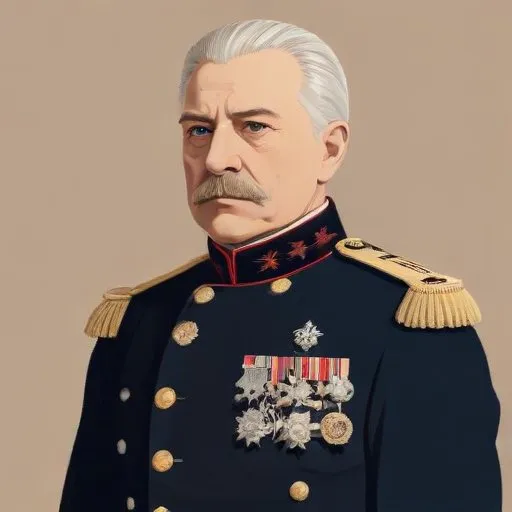
A renowned Prussian military leader, he played a crucial role in the Napoleonic Wars and later became a prominent figure in the unification of Germany. He's remembered for his bravery and strategic prowess on the battlefield.
Friedrich Graf von Wrangel, affectionately known as "Papa Wrangel," was a renowned Prussian Generalfeldmarschall who left an indelible mark on the annals of military history. This Baltic German nobleman was distinguished for his exceptional leadership and tactical prowess, earning him the respect and admiration of his contemporaries and later generations alike.
Wrangel was born on April 13, 1784, in Stettin, Pomerania (now Szczecin, Poland), into the esteemed Wrangel family. His uncle, Ferdinand von Wrangel, would later become a world-famous explorer. Friedrich's early life was marked by a desire to serve his country, and in 1796, he enlisted in a dragoon regiment, quickly rising through the ranks to become a second lieutenant in 1798.
Distinguishing himself as a subaltern during the Napoleonic Wars, Wrangel showcased his bravery at Heilsberg in 1807, earning the prestigious Order Pour le Mérite. Following the reorganization of the Prussian Army, he advanced to lieutenant colonel and played a crucial role in the War of Liberation in 1813, receiving the Iron Cross at Wachau, near Leipzig.
Wrangel's remarkable career saw him command a cavalry brigade in 1821, followed by a promotion to major general in 1823. He subsequently commanded the 13th Division, with headquarters in Münster, Westphalia, where he effectively quelled riots sparked by differences between the Archbishop of Cologne and the Crown.
In 1848, Wrangel led the II Corps of the German Confederation's army during the First Schleswig War, earning a promotion to General of Cavalry. Despite his military successes, he faced pressure from European powers to withdraw Prussian forces from the duchies. In a bold move, Wrangel refused, citing his allegiance to the regent of Germany rather than the King of Prussia.
Wrangel was known for his unwavering determination, strategic brilliance, and strong sense of justice. These traits earned him the respect of his peers, including the Junkers, and the admiration of King Frederick William IV. After his military career, Wrangel continued to serve as a respected statesman, passing away on November 2, 1877, at the age of 93.
Friedrich Graf von Wrangel's remarkable military career and unwavering commitment to justice left a lasting impact on Prussian and German history. His bravery, strategic acumen, and strength of character have inspired generations of military leaders and statesmen, cementing his place as one of the most illustrious Generalfeldmarschalls in Prussian history.
Born in 1712
Prussian king who ruled with Enlightenment values, promoting arts, education, and religious tolerance, while also being a skilled military strategist and expanding his kingdom through wars.
Born in 1769
A French military leader who rose to prominence during the French Revolution and became Emperor of France, known for his military conquests and reorganization of Europe. He is also famous for his Napoleonic Code, which remains a foundation of modern law.
Born in 1847
A German field marshal and politician who served as the 2nd President of Germany during the Weimar Republic, playing a crucial role in the rise of the Nazi Party. He's infamous for appointing Adolf Hitler as Chancellor of Germany in 1933.
Born in 1865
A German general and politician who played a crucial role in World War I, masterminding the 1918 Spring Offensive and later promoting Nazi ideology.
Born in 1888
A pioneering tank commander who revolutionized modern warfare with his innovative blitzkrieg tactics, earning him the nickname "Father of the Panzerwaffe".
Born in 1887
A highly decorated military strategist who played a crucial role in several key battles during World War II, including the invasion of France and the Siege of Leningrad.
Born in 1881
A German field marshal who played a crucial role in the Nazi war effort, serving as the commander-in-chief of the German Army from 1938 to 1941. He was a key figure in the invasion of Poland and the Battle of France.
