


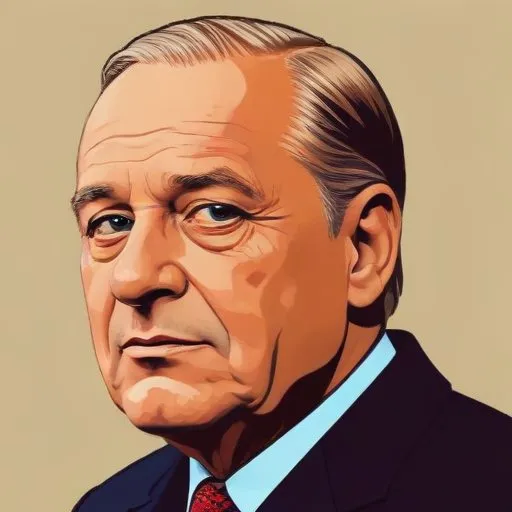
A German politician who served as a Member of the European Parliament and was a key figure in shaping the European Union's economic and monetary policies. He played a crucial role in creating the European single market and introducing the euro currency.
Fritz Hellwig, born on August 3, 1912, was a prominent German CDU politician and European Commissioner, best known for his influential role in shaping the country's economic policies and his remarkable life that spanned over a century.
Hellwig was born in Saarbrücken, in the then-Rhine Province of Prussia. After completing his schooling in 1930, he went on to study philosophy, national economy, political sciences, and history at the universities of Marburg, Vienna, and Humboldt University of Berlin.
In 1933, Hellwig received his doctorate with a study on 'The Fight for the Saar 1860-1870', and later in 1936, he concluded his Habilitation with a work on the Saarland industrialist Carl Ferdinand von Stumm-Halberg.
From 1933 to 1939, Hellwig worked in the Saarbrücken Chamber of Commerce and Industry, and from 1937, he was also a lecturer at the Saarbrücken teacher training university.
During World War II, Hellwig served in the armed forces from 1943 to 1947. After his dismissal, he became an economic adviser in Düsseldorf and Duisburg.
In 1951, Hellwig became the acting director of the German industrial institute in Cologne and chairman of the German Saarbundes, where his analysis had a crucial influence on the Saarpolitik of Chancellor Konrad Adenauer.
Hellwig initially belonged to the Centre Party but joined the CDU in 1947. He immediately became a member of the political-economic committee for the Rhineland and later was selected for the federal committee for economic policy and the federal executive committee.
Hellwig turned 100 in August 2012, making him one of the oldest politicians in German history. He passed away on July 22, 2017, at the age of 104, leaving behind a legacy as the last surviving member of the Second Bundestag.
Fritz Hellwig's remarkable life and career have left an indelible mark on German politics and economy. His extensive experience and expertise in economic policy have shaped the country's development, and his influence will be remembered for generations to come.
Born in 1876
Led post-war West Germany's reconstruction and served as a key figure in shaping the country's modern identity, earning him the title "Father of the Federal Republic."
Born in 1897
The second Chancellor of West Germany, a key figure in the country's post-war economic miracle, known for his liberal economic policies and leadership during a period of rapid growth and reconstruction.
Born in 1904
A German lawyer and politician who served as Chancellor of Germany from 1966 to 1969, known for his role in rebuilding post-war Germany and his efforts to come to terms with the country's Nazi past.
Born in 1913
A German statesman who served as Chancellor of Germany, known for his efforts to reconcile with Eastern Europe and his "Ostpolitik" policy, earning him a Nobel Peace Prize.
Born in 1918
A German leader who served as Chancellor from 1974 to 1982, known for his pragmatic and socially liberal policies, and his key role in shaping the European Union. He was also a respected economist and published author.
96 Years Old
The first unified Germany's leader, who oversaw the country's reunification after the Berlin Wall's fall, and is credited with creating a strong, stable economy.
82 Years Old
The 7th Chancellor of Germany, a lawyer-turned-politician, led the country from 1998 to 2005, implementing significant economic and social reforms. He's known for his efforts to modernize Germany and strengthen the European Union.
72 Years Old
The first female Chancellor of Germany, serving for 16 years, known for her leadership during the European sovereign-debt crisis and her role in shaping the European Union's policy. She's a highly influential figure in modern politics.
