


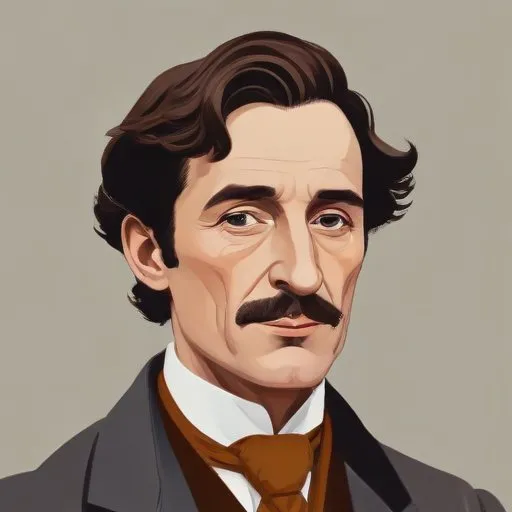
A Victorian-era literary mastermind, celebrated for crafting complex, psychologically nuanced novels and poetry that probed the human condition. His works often explored themes of love, morality, and social class.
George Meredith, a renowned English novelist and poet, was born on February 12, 1828, in Portsmouth, Hampshire, England. He is celebrated for his innovative novels that probed the realms of human psychology, social change, and literary complexity, earning him a reputation as one of the pioneers of the Victorian era.
Meredith was the only child of Augustus Urmston Meredith and Jane Eliza Macnamara. His mother's untimely death when he was just five years old led to his father's remarriage in 1839. The family's financial struggles forced them to relocate to London, where Meredith's father worked as a naval outfitter.
Initially, Meredith's focus was on poetry, influenced by the works of John Keats and other notable poets. His early poems reflected his fascination with nature, love, and the human condition. His poetic style, characterized by syntactic complexity, was often likened to "chaos illumined by brilliant flashes of lightning" by Oscar Wilde.
Meredith's transition to novel writing marked a significant shift in his literary career. His first novel, The Ordeal of Richard Feverel (1859), caused a stir in Victorian literary circles due to its bold exploration of themes such as marriage, family, and social expectations. This was followed by The Egoist (1879), considered one of his most enduring works, and Diana of the Crossways (1885), which achieved immense popularity during his lifetime.
Meredith's innovative approach to novel writing, which emphasized character psychology and social commentary, influenced a generation of writers, including Robert Louis Stevenson and George Gissing. He was nominated for the Nobel Prize in Literature seven times, a testament to his significant contributions to English literature.
Meredith's literary works reflected his philosophical leanings, which emphasized individualism, free will, and social reform. His writing often explored the complexities of human nature, love, and relationships, revealing a deep understanding of the human condition.
Meredith's literary contributions have had a lasting impact on modern society, shaping the way writers approach character development, social commentary, and literary style. His influence can be seen in the works of many notable authors, from Henry James to Virginia Woolf.
"The man who sets out to seek the prize of wisdom wins nothing but his own contempt."
Meredith's life and works are a testament to the complexities and contradictions of the Victorian era. His innovative approach to literature has left an indelible mark on English literature, ensuring his place among the pantheon of great writers.
Meredith's unique blend of poetry and prose, combined with his focus on character psychology, set him apart from his contemporaries. His writing style, though often compared to that of Oscar Wilde, retained a distinctiveness that has secured his place in literary history.
Born in 1811
Satirical novelist and illustrator of Victorian society, known for his witty and insightful portrayals of the English upper class, particularly in his novel "Vanity Fair".
Born in 1812
A renowned author of timeless classics, crafting vivid stories that exposed social injustices and explored the human condition, leaving an indelible mark on literature.
Born in 1810
A pioneering novelist of the Victorian era, known for her insightful portrayals of social class and women's lives in industrial England, particularly in her novel "North and South".
Born in 1840
A renowned author of novels and poetry that explored the human condition, often critiquing social conventions and the role of fate in people's lives.
Born in 1819
A renowned 19th-century English novelist and poet, celebrated for crafting complex, psychologically nuanced characters and exploring social issues in works like "Middlemarch" and "Silas Marner".
Born in 1850
A Scottish novelist, poet, and essayist who wrote iconic adventure novels, including "Treasure Island" and "Dr. Jekyll and Mr. Hyde", that have captivated readers for generations.
Born in 1854
A witty and flamboyant literary mastermind, renowned for crafting clever, humorous, and poignant works that continue to delight audiences with their clever wordplay and societal commentary.
Born in 1843
A renowned literary mastermind, celebrated for crafting psychologically complex, atmospheric novels and short stories that probed the human condition, often exploring the intricacies of the American and European aristocracy.
