


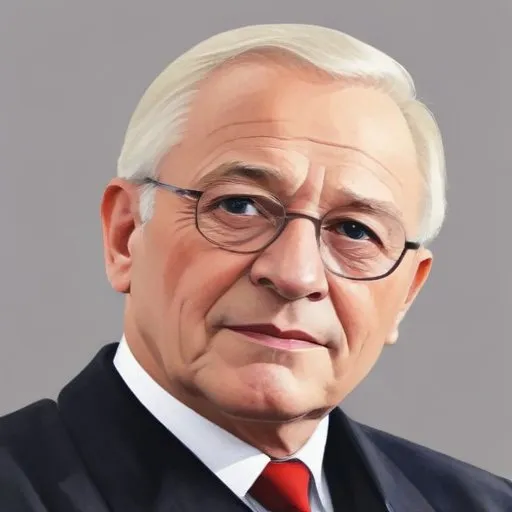
The 3rd President of West Germany, a lawyer and politician who played a key role in shaping the country's post-war identity and advocated for social justice and human rights. He's remembered for his commitment to democracy and reconciliation.
Gustav Heinemann is remembered as a champion of democracy and human rights, serving as the President of West Germany from 1969 to 1974. During his tenure, he worked tirelessly to promote liberal democracy, social justice, and international cooperation, earning him the respect and admiration of his contemporaries and future generations.
Heinemann was born on July 23, 1899, in Schwelm, Germany, to Otto Heinemann, a manager at the Krupp steelworks in Essen, and his wife, Johanna. His maternal grandfather, a participant in the Revolution of 1848, instilled in him the values of radical democracy, left-liberalism, and patriotism.
Heinemann pursued his elite secondary education and later studied law, economics, and history at various universities, including Mnster, Marburg, Munich, Gttingen, and Berlin. He graduated in 1922 and earned his Ph.D. in 1922 and a doctorate of law in 1929.
Heinemann's career was marked by several notable milestones:
Heinemann's life was guided by his commitment to liberal democracy, human rights, and social justice. He believed in the importance of intellectual independence and fought against subservience in all its forms.
Throughout his life, Heinemann maintained close friendships with individuals from diverse backgrounds, including Wilhelm Rpke, Ernst Lemmer, and Viktor Agartz, demonstrating his ability to bridge ideological divides.
Heinemann's presidency marked a significant turning point in West Germany's post-war development. He promoted reconciliation with Eastern Europe, supported European integration, and advocated for social justice and human rights.
His commitment to democracy and human rights has inspired generations of politicians, activists, and citizens, earning him the reputation as a champion of democracy and human rights.
Heinemann received numerous awards and honors for his services to democracy and human rights, including:
Gustav Heinemann's life and legacy serve as a testament to the power of democracy, human rights, and social justice. His unwavering commitment to these values has inspired countless individuals and continues to shape Germany's political landscape.
Today, Heinemann's legacy is remembered through various institutions, including the Gustav Heinemann Initiative, which promotes democracy, human rights, and international cooperation.
Did you know that Heinemann was a talented musician and played the violin in his free time?
Heinemann's great-grandfather participated in the Revolution of 1848, which aimed to establish a unified German state with a constitutional monarchy.
Heinemann's friendship with Viktor Agartz, a Marxist, demonstrates his ability to build bridges across ideological divides.
Gustav Heinemann's life is a powerful reminder of the importance of standing up for democracy, human rights, and social justice, inspiring future generations to continue his legacy.
Born in 1876
Led post-war West Germany's reconstruction and served as a key figure in shaping the country's modern identity, earning him the title "Father of the Federal Republic."
Born in 1913
A German statesman who served as Chancellor of Germany, known for his efforts to reconcile with Eastern Europe and his "Ostpolitik" policy, earning him a Nobel Peace Prize.
Born in 1918
A German leader who served as Chancellor from 1974 to 1982, known for his pragmatic and socially liberal policies, and his key role in shaping the European Union. He was also a respected economist and published author.
96 Years Old
The first unified Germany's leader, who oversaw the country's reunification after the Berlin Wall's fall, and is credited with creating a strong, stable economy.
82 Years Old
The 7th Chancellor of Germany, a lawyer-turned-politician, led the country from 1998 to 2005, implementing significant economic and social reforms. He's known for his efforts to modernize Germany and strengthen the European Union.
71 Years Old
The first female Chancellor of Germany, serving for 16 years, known for her leadership during the European sovereign-debt crisis and her role in shaping the European Union's policy. She's a highly influential figure in modern politics.
Born in 1884
First President of post-war Germany, credited with rebuilding the country and promoting democracy. He's also known for his strong advocacy for human rights and freedom of the press.
Born in 1904
A German lawyer and politician who served as Chancellor of Germany from 1966 to 1969, known for his role in rebuilding post-war Germany and his efforts to come to terms with the country's Nazi past.
