


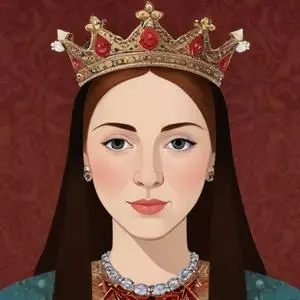
First Tudor king of England, united warring noble families, established stability and prosperity after Wars of the Roses. Founded Tudor dynasty, paved way for famous children and grandchildren.
Henry VII, the first monarch of the House of Tudor, is best known for ending the Wars of the Roses and bringing peace and stability to England after decades of civil war. Through his shrewd diplomacy, military prowess, and administrative reforms, he cemented his legacy as a unifying force in English history.
Born on January 28, 1457, Henry VII was the son of Edmund Tudor, 1st Earl of Richmond, and Margaret Beaufort, a descendant of John of Gaunt. After his father's death, Henry's early years were marked by exile in Brittany, where he spent 14 years in hiding from the Yorkist regime.
Henry's chance to claim the throne came in 1485, when he led a force of French, Scottish, and Welsh troops against Richard III at the Battle of Bosworth Field. Emerging victorious, Henry became the King of England and Lord of Ireland, marking the end of the Plantagenet dynasty and the beginning of the Tudor era.
Henry's first act as king was to marry Elizabeth of York, daughter of Edward IV, thereby uniting the rival houses of Lancaster and York. He then set about restoring order and stability to the kingdom, introducing reforms to strengthen the economy, improve administration, and promote trade.
Henry VII reigned for nearly 24 years, leaving behind a legacy of peace, stability, and prosperity. He was succeeded by his son, Henry VIII, who would go on to shape English history in his own distinctive way. Despite his reputation as a frugal and calculating ruler, Henry VII's administrative reforms and diplomatic achievements have earned him a place as one of England's most important monarchs.
Henry VII's reign marked a turning point in English history, ending the Wars of the Roses and paving the way for the Tudor dynasty's golden age. His administrative reforms and diplomatic achievements have had a lasting impact on English politics, economy, and culture, cementing his place as one of the most important monarchs in English history.
Born in 1533
The Virgin Queen, a powerful and beloved monarch, ruled England during a golden age of culture, literature, and exploration, establishing the Church of England and defeating the Spanish Armada.
Born in 1491
A larger-than-life monarch who ruled England with an iron fist, infamous for his six marriages and the English Reformation.
Born in 1284
The king whose disastrous reign led to his eventual deposition and mysterious death, remembered for his alleged homosexual relationships and power struggles with nobles.
Born in 1485
Spanish princess who became the queen consort of England, playing a central role in the English Reformation and sparking the creation of the Church of England.
Born in 1478
A renowned Renaissance humanist and statesman who served as Lord Chancellor of England, famous for his literary work "Utopia" and his martyrdom for refusing to acknowledge the English monarch's supremacy over the Church.
Born in 1489
Leader of the English Reformation, instrumental in creating the Church of England and authoring the Book of Common Prayer.
