


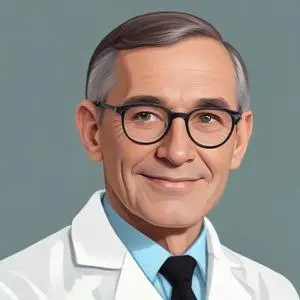
Developed vaccines for measles, mumps, and rubella, revolutionizing pediatric medicine and saving countless lives.
Renowned American biomedical scientist John Franklin Enders is credited with revolutionizing the field of vaccine development, earning him the esteemed title of "The Father of Modern Vaccines." His groundbreaking research led to the discovery of the ability of poliomyelitis viruses to grow in cultures of various types of tissue, paving the way for the development of vaccines against polio and other diseases.
Born on February 10, 1897, in West Hartford, Connecticut, Enders came from a wealthy family. His father, John Ostrom Enders, was the CEO of the Hartford National Bank and left him a substantial inheritance of $19 million upon his passing. Enders' education took him to the Noah Webster School in Hartford and later to St. Paul's School in Concord, New Hampshire. He briefly attended Yale University before joining the United States Army Air Corps in 1918 as a flight instructor and lieutenant.
After World War I, Enders returned to Yale, where he graduated and later became a member of the prestigious Scroll and Key and Delta Kappa Epsilon societies. He ventured into real estate in 1922 but soon shifted his focus to the biomedical field, earning a PhD in infectious diseases from Harvard in 1930. His academic journey led him to join the faculty at Children's Hospital Boston, where he would make his mark on the scientific community.
In 1949, Enders, along with Thomas Huckle Weller and Frederick Chapman Robbins, successfully cultured an animal virus – poliovirus – in vitro. This pioneering work earned the trio the 1954 Nobel Prize in Physiology or Medicine. Their discovery enabled the growth of viruses in cultures of various tissues, facilitating the development of vaccines against polio and other diseases.
The Enders-Weller-Robbins technique laid the foundation for Jonas Salk's development of the polio vaccine in 1952. Although Salk became a public hero, he failed to acknowledge the contributions of other researchers, leading to his estrangement from the scientific community. Enders' work extended beyond polio, as he and Thomas C. Peebles isolated the measles virus from an 11-year-old boy, David Edmonston, in 1954.
Enders passed away on September 8, 1985, at the age of 88, leaving behind a legacy that continues to inspire generations of scientists and researchers. His wife, who survived him, passed away in 2000. Through his groundbreaking work, Enders has saved countless lives and continues to shape the landscape of modern vaccine development.
As we reflect on the life and achievements of John Franklin Enders, we are reminded of the power of dedication, perseverance, and innovation in shaping the course of human history.
Born in 1914
Developed the first inactivated poliovirus vaccine, leading to the near eradication of polio, and founded the Salk Institute for Biological Studies.
Born in 1906
A Polish-American physician and virologist who developed the oral polio vaccine, saving millions of lives and nearly eradicating the disease. His work has had a lasting impact on global public health.
Born in 1749
Developed the smallpox vaccine, revolutionizing disease prevention and saving countless lives.
Born in 1822
Developed vaccines for rabies and anthrax, and pioneered the germ theory of disease, revolutionizing our understanding of microbiology and disease prevention.
Born in 1843
A pioneering microbiologist and physician who discovered the bacteria that cause tuberculosis, cholera, and anthrax, revolutionizing the field of microbiology and saving countless lives.
Born in 1854
Developed the first vaccine against diphtheria and tetanus, revolutionizing the treatment of bacterial infections. Pioneered the field of immunology and saved countless lives.
Born in 1749
Developed the smallpox vaccine, revolutionizing disease prevention and saving countless lives.
Born in 1881
Discovered penicillin, a revolutionary antibiotic, and pioneered its use in medicine. This breakthrough has saved countless lives and transformed the field of healthcare.
