


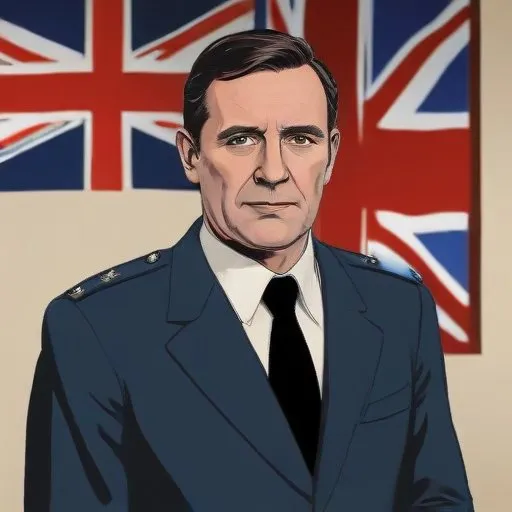
A decorated war hero who later became the Prime Minister of Australia, leading the country through a period of significant social and economic change. He's also known for his strong leadership style and commitment to Australian independence.
Known for his unwavering leadership and dedication to Australia, Sir John Grey Gorton served as the country's 19th prime minister from 1968 to 1971, making him a significant figure in Australian politics. As the first and only member of the upper house of the Parliament of Australia to assume the office of prime minister, Gorton's legacy continues to inspire and fascinate Australians to this day.
Born out of wedlock on September 9, 1911, Gorton's childhood was marked by turbulence. Despite these challenges, he went on to study at the prestigious Geelong Grammar School and later attended Brasenose College, Oxford, where he honed his skills and prepared for a life of service.
In 1940, Gorton enlisted in the Royal Australian Air Force, becoming a fighter pilot in Malaya and New Guinea during World War II. His bravery and skill in battle earned him recognition, but it was his heroism during a crash landing on Bintan Island in 1942 that showcased his unwavering resolve. Despite suffering severe facial injuries, Gorton continued to serve his country, even after his ship was torpedoed and sunk by a Japanese submarine while being evacuated.
After being discharged from the war in 1944, Gorton returned to farming and eventually entered politics, serving on the Kerang Shire Council in 1946 and later becoming shire president. His political career gained momentum when he was elected to the Senate at the 1949 federal election, where he quickly established himself as a strident anti-communist and vocal advocate for foreign policy.
Throughout the 1950s and 1960s, Gorton held various portfolios in the governments of Sir Robert Menzies and Harold Holt, including roles in the Royal Australian Navy, public works, education, and science. His leadership skills and dedication to his country earned him a promotion to the Cabinet in 1966 and eventually, the leadership of the Liberal Party.
Gorton's legacy extends far beyond his tenure as prime minister. He played a pivotal role in shaping Australia's foreign policy, education system, and scientific advancements. As a war hero, farmer, and statesman, Gorton's life serves as a testament to the power of determination, hard work, and service to one's country.
Gorton's political ideology was deeply rooted in his anti-communist stance, which guided his foreign policy decisions and leadership. His commitment to education and scientific advancements demonstrated his dedication to the betterment of Australian society.
Gorton's legacy extends beyond the realm of politics, influencing modern Australian society through his contributions to education, science, and national security. His leadership during a pivotal moment in Australian history has left an indelible mark on the country's development.
In the midst of the Cold War, Gorton's unwavering stance against communism and his commitment to national security earned him both praise and criticism. Despite the controversies surrounding his leadership, Gorton's legacy remains a testament to the power of strong leadership and dedication to one's country.
Born in 1894
The 12th Prime Minister of Australia, a lawyer-turned-politician who played a crucial role in shaping the country's post-war economy and foreign policy, and is often credited with establishing the modern Australian identity.
Born in 1908
The 17th Prime Minister of Australia, a lawyer-turned-politician who mysteriously disappeared while swimming, leaving behind a legacy of economic reform and a nation's unanswered questions.
Born in 1900
An Australian farmer-turned-politician who served as the country's 18th Prime Minister, known for his brief but significant tenure during a time of great change. He played a crucial role in shaping the nation's economy and foreign policy.
Born in 1908
The 20th Prime Minister of Australia, serving from 1971 to 1972, known for his brief but tumultuous tenure marked by controversy and policy reversals. He's also remembered for his colorful personal life and fashion sense.
Born in 1916
The 21st Prime Minister of Australia, a lawyer, and lieutenant who introduced sweeping social and economic reforms, including universal healthcare and free education, and played a significant role in shaping the country's modern identity.
96 Years Old
The 22nd Prime Minister of Australia, serving from 1975 to 1983, known for leading the country through a period of significant social and economic change, and for his strong stance on human rights and multiculturalism.
96 Years Old
Leader of the Australian Labor Party who served as Prime Minister from 1983 to 1991, known for his charismatic leadership and economic reforms.
82 Years Old
The 24th Prime Minister of Australia, a Labor Party leader who implemented significant economic reforms, including deregulation and privatization, and is known for his bold and charismatic leadership style.
