


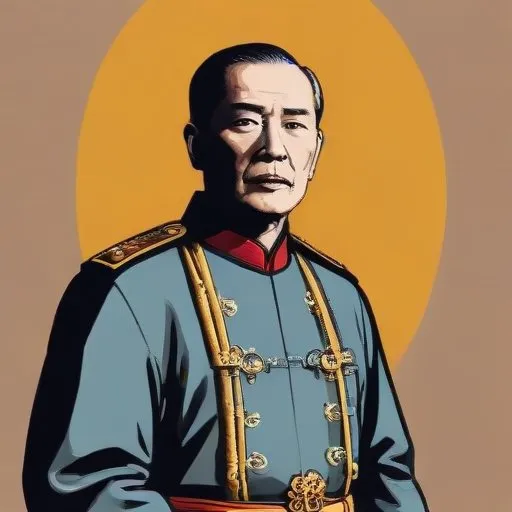
A renowned military strategist, statesman, and poet who played a key role in the founding of the Ming dynasty and is celebrated for his wisdom and literary talents.
Liu Bowen, also known as Liu Ji, was a renowned Chinese military strategist, philosopher, and politician who left an indelible mark on the late Yuan and early Ming dynasties. He is famously recognized for his prophetic abilities, earning him the nickname "the Divine Chinese Nostradamus."
Born on July 1, 1311, in Qingtian County, present-day Wencheng County, Lishui, Zhejiang, Liu Bowen's life was marked by his unwavering dedication to serving the state and his unblemished reputation as a sage. He served as a key advisor to Zhu Yuanzhang, the Hongwu Emperor, playing a pivotal role in the latter's struggle to overthrow the Yuan dynasty and unify China proper under his rule.
Liu Bowen's intellect knew no bounds. He co-edited the esteemed military treatise, the Huolongjing (Fire Dragon Manual), alongside Jiao Yu, showcasing his expertise in military technology. His philosophical outlook was that of a skeptical naturalist, and he was fascinated by various fields, including astronomy, calendrical science, magnetism, and fengshui. His association with the mathematician and alchemist Zhao Yuqin further underscores his versatile nature.
Liu Bowen's prophetic abilities earned him both admiration and suspicion. He warned the Hongwu Emperor that Hu Weiyong was unsuitable for the position of prime minister, a warning that ultimately led to his resignation. His untimely death, suspected to be a result of poisoning by the emperor and Hu Weiyong, became the first of the Four Major Cases of the early Ming dynasty, leaving behind a legacy of wisdom and intrigue.
Liu Bowen's life was a testament to his unwavering dedication to serving the state and his unrelenting pursuit of knowledge. As a visionary, strategist, and philosopher, he left an indelible mark on the annals of Chinese history, securing his place as one of the most revered figures of the Ming dynasty.
"Thunder is like fire shot from a cannon."
This poignant quote not only showcases Liu Bowen's fascination with the workings of the universe but also underscores his profound understanding of the intricate relationships between natural phenomena and human innovation.
Liu Bowen's prophetic abilities, military strategies, and philosophical contributions continue to inspire and intrigue scholars and enthusiasts alike. His legacy serves as a testament to the power of visionary thinking, intellectual curiosity, and unwavering dedication to the pursuit of knowledge.
In conclusion, Liu Bowen's life and legacy are a testament to the boundless human potential, a shining example of what can be achieved when intellect, creativity, and wisdom converge.
Born in 1893
Leader of the Chinese Communist Party who implemented radical social and economic reforms, including the Great Leap Forward and the Cultural Revolution, shaping modern China's politics and economy.
Born in 1886
A prominent Chinese military leader and politician who played a crucial role in the Chinese Civil War and the establishment of the People's Republic of China, serving as the second-in-command to Mao Zedong. He's most known for his military strategies and leadership during the war.
Born in 1898
The first Premier of the People's Republic of China, serving from 1949 until his death in 1976, is most known for his key role in the Chinese Communist Party and his diplomatic efforts to improve relations with the West. He played a crucial part in shaping China's foreign policy and economy during a pivotal period in the country's history.
Born in 1898
A prominent military leader who played a crucial role in the Chinese Civil War and later became a key figure in the Communist Party, known for his criticisms of Mao's policies. He was eventually purged and persecuted during the Cultural Revolution.
Born in 1907
A powerful Chinese military leader and politician who rose to prominence during the Chinese Civil War and later became a close ally of Mao Zedong, playing a crucial role in the Cultural Revolution. He is infamous for his alleged plot to overthrow Mao and his mysterious death in a plane crash.
Born in 1896
A prominent Chinese military leader and politician who played a key role in the Chinese Civil War and later served as the 1st Vice Premier of the People's Republic of China, known for his efforts in modernizing the Chinese military. He was a close ally of Mao Zedong and helped establish the People's Liberation Army.
Born in 1904
A Chinese revolutionary and statesman who led the country's economic reforms, transforming it into a global superpower. He's credited with opening up China to the world and introducing capitalist principles.
73 Years Old
A renowned Chinese violinist and composer, blending Eastern and Western musical styles, creating a unique sound that showcases cultural fusion.
