


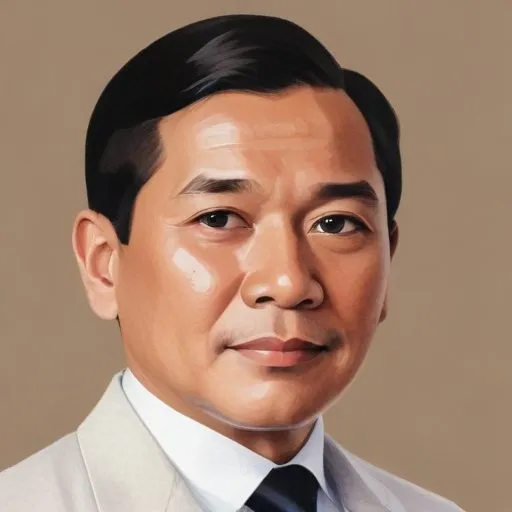
A Filipino lawyer and politician who served as the 4th Governor of Rizal, known for his contributions to the country's governance and development. He played a significant role in shaping the province's politics and economy.
Lope K. Santos is renowned for his groundbreaking 1906 socialist novel, Banaag at Sikat, and his significant contributions to the development of Filipino grammar and Tagalog orthography. Through his works, Santos left an indelible mark on the country's literary landscape, earning him a place among the most influential Filipino writers of all time.
Santos was born on September 25, 1879, in Pasig, Province of Manila, to Ladislao Santos and Victorina Canseco. His father, a native of Pasig, was imprisoned during the Philippine Revolution for possessing copies of José Rizal's Noli Me Tangere and Ang Kalayaan. Santos was raised in Pandacan and pursued his education at the Escuela Normal Superior de Maestros (Higher Normal School for Teachers) and later at Colegio Filipino.
In 1900, Santos started writing his own newspaper, Ang Kaliwanagan, which marked the beginning of his writing career. During the Philippine Revolution of 1896, Santos joined the revolutionaries, demonstrating his commitment to the country's struggle for independence.
His most notable work, Banaag at Sikat, was published in 1906 and is considered a pioneering work in Filipino socialist literature. The novel explores the struggles of the working class and the need for social change, reflecting Santos' deep understanding of the socio-political landscape of his time.
In addition to his literary accomplishments, Santos was an advocate for labor rights and social justice. He was involved with the Union Obrera Democratica Filipina (Philippine Democratic Labor Union) and later founded the Union del Trabajo de Filipinas, which aimed to promote workers' welfare and protect their rights.
Santos' commitment to social justice and his contributions to the development of Filipino literature earned him a seat in the Philippine Senate, where he served as a senator from 1916 to 1919.
Santos' work was deeply rooted in socialist ideology, which emphasized the importance of social equality and justice. Through his writing, he advocated for the empowerment of the working class and the need for collective action to bring about social change.
Santos' contributions to Filipino literature and grammar have had a lasting impact on the country's cultural and educational landscape. His work has inspired generations of Filipino writers and continues to be studied and appreciated today.
Through his literary and political efforts, Santos has left an indelible mark on the Philippines, cementing his place as one of the country's most important writers and thinkers of the 20th century.
Born in 1869
Led the Philippine Revolution against Spanish colonial rule and later established the First Philippine Republic, becoming its first president. He's revered as a national hero for his fight for independence.
Born in 1878
The 2nd President of the Philippines, a key figure in the country's fight for independence from the US, known for his leadership during World War II and establishing a government-in-exile.
Born in 1878
The 4th President of the Philippines, a lawyer and politician who played a key role in the country's transition from American colonial rule to independence. He's most known for his efforts in rebuilding the war-torn nation after World War II.
Born in 1892
This Filipino leader served as the 5th President of the Philippines, playing a key role in rebuilding the country after World War II and shaping its post-war economy. He's remembered for his efforts to restore national sovereignty and promote economic growth.
Born in 1890
The 6th President of the Philippines was a leader who played a crucial role in rebuilding the country after World War II, and is known for his efforts to restore the economy and promote national unity.
Born in 1907
A Filipino leader who served as president from 1953 to 1957, known for his anti-corruption and social reform efforts, as well as his tragic death in a plane crash.
Born in 1896
The 8th President of the Philippines, a lawyer and politician, led the country towards economic growth and independence, implementing the Filipino First Policy to promote national development.
Born in 1917
A Filipino leader who ruled with an iron fist, implementing martial law and amassing wealth, leaving a legacy of controversy and economic turmoil.
