


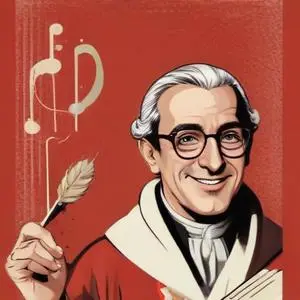
A priest and poet who collaborated with Mozart on iconic operas like "The Marriage of Figaro" and "Don Giovanni", leaving an indelible mark on classical music.
Lorenzo Da Ponte, an Italian-born American opera librettist, poet, and Roman Catholic priest, is renowned for penning the libretti for 28 operas, including three of Mozart's most celebrated works: The Marriage of Figaro (1786), Don Giovanni (1787), and Così fan tutte (1790). His collaborations with Mozart remain some of the most iconic in opera history, cementing Da Ponte's status as a leading figure in the world of opera.
Born Emanuele Conegliano on March 10, 1749, in Ceneda, Republic of Venice (now Vittorio Veneto, Italy), Da Ponte was the eldest of three sons to a Jewish family. In 1764, his father converted the family to Roman Catholicism, and Emanuele took the name Lorenzo Da Ponte from the bishop who baptized him.
Da Ponte studied at the Ceneda seminary and later at the seminary at Portogruaro, where he took Minor Orders in 1770 and became Professor of Literature. He was ordained a priest in 1773 and began writing poetry in Italian and Latin, including an ode to wine, Ditirambo sopra gli odori.
In 1773, Da Ponte moved to Venice, where he made a living as a teacher of Latin, Italian, and French. However, his dissolute lifestyle led to a trial in 1777, where he was charged with public concubinage and abduction of a respectable woman.
It was during this period that he met Giacomo Casanova, with whom he formed a close friendship that would last over 20 years. Both were Venetian adventurers, kindred spirits, and seducers, and Casanova would later feature Da Ponte in his memoirs.
In 1805, Da Ponte emigrated to the United States, where he became the first professor of Italian literature at Columbia University and, with Manuel Garcia, introduced Italian opera to America.
Da Ponte's legacy extends far beyond his work with Mozart. He played a crucial role in popularizing Italian opera in America, paving the way for future generations of opera lovers. Today, he is remembered as a trailblazing librettist, poet, and educator who left an indelible mark on the world of opera.
"I am a man of the world, and the world is a theater."
Da Ponte's contributions to opera and education have had a lasting impact on modern society. His work with Mozart has inspired countless productions, adaptations, and reinterpretations, ensuring the continued relevance of opera in contemporary culture.
As a pioneering figure in introducing Italian opera to America, Da Ponte paved the way for future generations of opera enthusiasts, performers, and educators. His legacy continues to inspire and enrich the lives of people around the world.
Born in 1774
A 19th-century Romantic painter and etcher, renowned for his mystical and contemplative landscapes that often featured ruins, mountains, and misty skies, evoking a sense of spirituality and connection to nature.
Born in 1729
Empress of Russia from 1762 to 1796, she transformed her country into a major European power, modernizing its culture, politics, and economy through numerous reforms and conquests.
Born in 1732
A renowned composer and pianist of the Classical period, known for his symphonies, operas, and chamber music that showcased his innovative and expressive style. He played a significant role in shaping the Classical music era.
Born in 1714
A pioneering opera composer who revolutionized the art form with his innovative and expressive works, blending music and drama in a way that captivated audiences.
Born in 1750
A renowned 18th-century composer and conductor, known for his operas and rivalry with Mozart, as depicted in the movie Amadeus.
Born in 1749
An 18th-century Italian composer and educator, known for his operas and sacred music, particularly his comic operas that showcased his mastery of melody and harmony.
Born in 1782
A virtuosic violinist and composer who revolutionized the instrument's technical possibilities, leaving an indelible mark on classical music.
