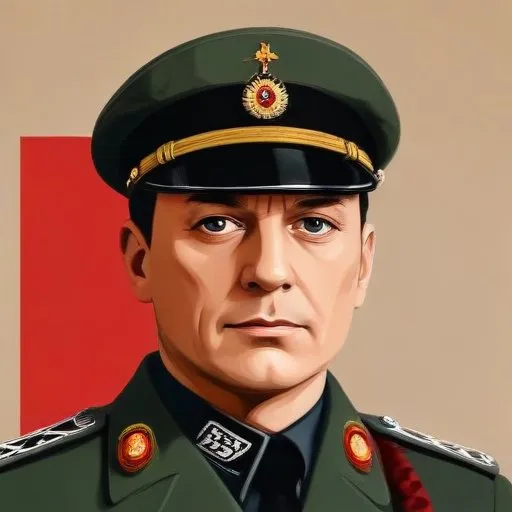
Luitpold Steidle

Luitpold Steidle

Luitpold Steidle was born on March 12th, 1898

Full Name: Luitpold Steidle
Nationality: German
Profession: Army officer, Politician
Field: Politics, Military
Occupation: Officer, Politician
Personality: Leader
Specialty: Military leadership
Birthplace: Germany

A German army officer and politician who served as the Minister of War and Commander of the Bavarian Army during World War I, known for his role in the war effort and military reforms.

Written by: David Williams David Williams

Luitpold Steidle: The Refreshingly Open-Minded German Army Officer and Politician

A Life of Service and Politics

Luitpold Steidle was a German army officer and East German politician who made a name for himself with his open-mindedness and distinctive leadership style. As a member of the CDU (Christian Democratic Union), Steidle navigated the complexities of German politics during the tumultuous mid-20th century.

Early Life and Education

Born on 12 March 1898, in Ulm, Kingdom of Wrttemberg, Steidle grew up in a Catholic family. His father, a senior military judge, instilled in him the values of service and duty. Steidle attended secondary school in Munich before joining the army in 1915, where he quickly rose to the rank of lieutenant by the end of World War I.

After the war, Steidle resumed his education, studying agricultural sciences at the Technical High School College in Munich. He later switched to hands-on training, learning farming at Hohenpolding and Grasselfing Olching, near Munich. In 1922, he set himself up as an independent farmer in Loibersdorf, Aying, between Munich and Rosenheim.

Rise to Prominence

Steidle's career took a turn in 1926 when he became a merchandise inspector, and later, a stud inspector near Kassel, in Beberbeck, one of Germany's leading stud centers. However, with the economic decline and rise of mechanized agriculture, the stud business struggled, and the principal stud at Beberbeck went into liquidation in 1929.

In 1933, Steidle joined the Nazi Party, which had recently seized power in Germany. He lost his job and experienced a period of unemployment, working briefly as an insurance agent before rejoining the army at the end of the year, recovering his officer's rank.

Political Career

Steidle's political career spanned several decades, during which he became known for his refreshing open-mindedness. As described by Der Spiegel in 1947, Steidle was a man with a "narrow distinctive face" in his late 40s, who brought a unique perspective to politics.

Throughout his political career, Steidle remained committed to serving his country, working tirelessly to promote the interests of the German people. Although he navigated the complexities of East German politics, his open-mindedness and willingness to listen earned him respect from his contemporaries.

Legacy

Luitpold Steidle's legacy is one of service, duty, and open-mindedness. Despite the tumultuous times in which he lived, Steidle remained committed to his values, working tirelessly to promote the interests of the German people. His refreshingly open-minded approach to politics continues to inspire generations, serving as a testament to the power of servant leadership.
Timeline
1898
Born in Germany
Luitpold Steidle was born on February 12, 1898, in Würzburg, Germany. He would later become a prominent army officer and politician.
1917
Joined German Army
Steidle joined the German Army in 1917 and served during World War I.
1933
Joined the Nazi Party
Steidle joined the Nazi Party in 1933 and became a prominent figure in the partys military wing.
1939
Fought in World War II
Steidle fought in World War II, serving on the Eastern Front and rising to the rank of Generalmajor.
1945
Captured by Allies
Steidle was captured by the Allies in 1945 and was later tried for war crimes.
Luitpold Steidle

Luitpold Steidle Quiz

Luitpold Steidle served as the Minister of War and Commander of the Bavarian Army during which global conflict?

Score: 0/5
FAQ
What was Luitpold Steidles military career like?
Luitpold Steidle was a German army officer who served during World War I and World War II. He rose to the rank of general and was known for his bravery and tactical skill.
What was Luitpold Steidles role in the post-war period?
After the war, Luitpold Steidle served as a politician and played a key role in rebuilding the German military. He was a strong advocate for German rearmament and served as a member of the Bundestag.
What awards did Luitpold Steidle receive for his military service?
Luitpold Steidle received several awards for his military service, including the Knights Cross of the Iron Cross and the German Cross in Gold.
What was Luitpold Steidles early life and education like?
Luitpold Steidle was born in Germany and studied at the Cadet Corps in Munich. He began his military career in 1903 and rose through the ranks quickly.
What is Luitpold Steidles legacy in German military history?
Luitpold Steidle is remembered as a decorated and respected military leader who played a key role in shaping Germanys military policy during the post-war period.

Related People:

Erwin Rommel

Born in 1891

A renowned World War II military strategist, known for leading the Afrika Korps and earning the respect of both allies and enemies with his tactical genius.

Heinz Guderian

Born in 1888

A pioneering tank commander who revolutionized modern warfare with his innovative blitzkrieg tactics, earning him the nickname "Father of the Panzerwaffe".

Fedor von Bock

Born in 1880

A German field marshal who led the Wehrmacht during World War II, playing a key role in the invasion of Poland and the Battle of Moscow. He was a prominent figure in the German high command during the war.

Erich Raeder

Born in 1876

A German naval leader who played a key role in the Kriegsmarine during World War II, overseeing the German U-boat fleet and naval operations. He was a close advisor to Adolf Hitler and implemented the German naval strategy during the war.

Karl Dönitz

Born in 1891

A German naval commander who led the U-boat fleet during World War II and briefly served as President of Germany after Hitler's death, known for his role in the war and its aftermath.

Wilhelm Keitel

Born in 1882

A high-ranking Nazi officer who served as the Chief of the OKW, the German High Command, during World War II, and was known for his unwavering loyalty to Hitler. He was tried and executed for war crimes after the war.

Alfred Jodl

Born in 1890

Chief of the German High Command during World War II, responsible for planning and executing military operations, and signing the unconditional surrender of Germany.

Walther von Brauchitsch

Born in 1881

A German field marshal who played a crucial role in the Nazi war effort, serving as the commander-in-chief of the German Army from 1938 to 1941. He was a key figure in the invasion of Poland and the Battle of France.