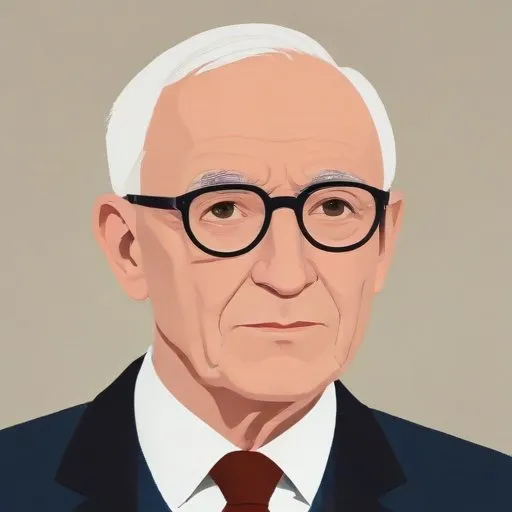
Maurice Allais: The Nobel Laureate Who Revolutionized Economic Theory
The Pioneer of Market Efficiency and Resource Allocation
Maurice Allais, a French physicist and economist, was awarded the Nobel Memorial Prize in Economic Sciences in 1988 for his groundbreaking contributions to the theory of markets and efficient utilization of resources. His work, which built upon the foundations laid by
John Hicks and
Paul Samuelson, formalized the self-regulation of markets, challenging the views of
John Maynard Keynes and paving the way for the neoclassical synthesis.
Early Life and Academic Pursuits
Born on May 31, 1911, in Paris, France, Allais attended the Lyce Lakanal and graduated from the École Polytechnique in Paris. He went on to study at the École Nationale Supérieure des Mines de Paris, where he later became a professor of economics in 1944. Allais also held teaching positions at various institutions, including the University of Paris X-Nanterre.
From Physics to Economics
Initially, Allais' research focused on the sciences of the concrete and experimental physics, particularly on pendular oscillations and the laws of gravitation. However, a trip to the United States in 1933 during the Great Depression sparked his interest in economics. This shift in focus led him to become one of the most influential economists of the 20th century.
Influences and Contributions
Allais cited
Léon Walras,
Vilfredo Pareto, and
Irving Fisher as his primary influences. Despite being a pioneer in his field, Allais' reluctance to write in or translate his work into English meant that many of his major contributions remained unknown to the dominant community until they were independently rediscovered or popularized by English-speaking economists.
Philosophical Contributions and Beliefs
Allais was a strong advocate for an important public sector and believed in the importance of self-regulation in markets. He was also critical of Keynes' liberalism, which further underscores his commitment to the neoclassical synthesis.
Career Highlights and Major Works
- Professor of Economics at the École Nationale Supérieure des Mines de Paris (1944)
- Director of the Economic Analysis Centre (1946)
- Doctorengineer from the University of Paris, Faculty of Science (1949)
- Published numerous works on pendular oscillations and the laws of gravitation
Awards and Honors
- Nobel Memorial Prize in Economic Sciences (1988)
Legacy
Maurice Allais' pioneering work has had a lasting impact on the field of economics, shaping our understanding of market efficiency and resource allocation. His legacy continues to inspire economists and policymakers around the world.
Personal Milestones and Key Life Events
- Born on May 31, 1911, in Paris, France
- Died on October 9, 2010, at the age of 99
Through his remarkable contributions, Maurice Allais has left an indelible mark on the world of economics. His work continues to influence contemporary economic thought, making him a true giant in his field.
FAQ
What was Maurice Allaiss profession?
Maurice Allais was a French economist and physicist, known for his work on econometrics and decision theory.
What was Maurice Allaiss most significant contribution to economics?
Maurice Allaiss most significant contribution to economics was his development of the theory of Allais paradox, which challenges traditional assumptions about human behavior and decision-making.
What awards did Maurice Allais receive for his work?
Maurice Allais was awarded the Nobel Memorial Prize in Economic Sciences in 1988 for his work on econometrics and decision theory.
What was Maurice Allaiss view on economic policy?
Maurice Allais was a vocal critic of government intervention in the economy and advocated for laissez-faire economic policies.
What is Maurice Allaiss legacy today?
Maurice Allaiss legacy is that of a pioneering economist and thinker, whose work continues to influence economic theory and policy debates.