


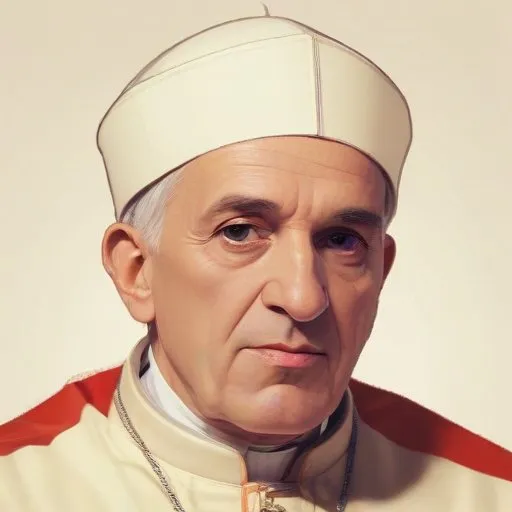
The 16th-century Pope who briefly reigned from 1590 to 1591, known for his short but eventful papacy marked by reforms and attempts to address corruption within the Catholic Church.
Pope Gregory XIV, born Niccolò Sfondrato, was a prominent figure in the Catholic Church, known for his unwavering commitment to reform and his brief yet significant papacy from 1590 to 1591.
Niccolò Sfondrato was born on February 11, 1535, in Somma Lombardo, Duchy of Milan, to a noble family. His mother, of the House of Visconti, passed away during childbirth, and his father, Francesco Sfondrati, later became a cardinal-priest.
Sfondrato pursued his education in law at Perugia and later at the University of Padua, where he graduated in utroque iure on March 2, 1555. His early years were marked by a modest lifestyle and stringent piety, which would shape his future as a reformer.
In 1552, Sfondrato was appointed as a senator in Milan by Philip II of Spain, and in 1557, he was urged by the Spanish government to become the Bishop of Cremona. This appointment materialized in 1560, following the election of Pope Pius IV.
Sfondrato was consecrated bishop in Milan on May 19, 1560, and actively participated in the Sessions of the Council of Trent from 1561 to 1563. During this period, he advocated for the divine origin of the residence of bishops in their diocese, a position that was not well-received by Rome.
On December 5, 1590, Sfondrato was elected as Pope Gregory XIV, succeeding Pope Urban VII. During his brief papacy, he continued to implement the reforms of the Council of Trent, focusing on the improvement of church discipline and the promotion of education.
One of his notable achievements was the establishment of the Congregation of the Holy Office, which aimed to combat heresy and maintain Catholic orthodoxy. Gregory XIV also showed a deep concern for the welfare of the poor, and his papacy was marked by a series of charitable initiatives.
Although Pope Gregory XIV's papacy was short-lived, his contributions to Catholic reform and his commitment to the improvement of the Church have left a lasting impact on its history.
Through his unwavering dedication to reform, Gregory XIV has become a symbol of the Catholic Church's ability to adapt and evolve, ensuring its continued relevance in the modern world.
"The Church is not a museum, but a living, breathing entity that must adapt to the needs of its faithful."
"The poor are not a burden, but a blessing, for they offer us an opportunity to demonstrate our love and compassion."
Born in 1568
The 17th-century Catholic leader who reigned for 21 years, known for his strong stance against Galileo Galilei and his scientific discoveries, as well as his extensive patronage of the arts.
Born in 1519
The 151st Pope of the Catholic Church, serving for only two months in 1591, he is mostly remembered for his brief and uneventful papacy.
Born in 1536
Led the Catholic Church during a tumultuous period, issuing papal bulls and playing a key role in the Counter-Reformation. He's also famous for his coffee habit, being the first Pope to try and approve of it.
Born in 1535
The second shortest-reigning pope in history, serving for just 27 days in 1605, he is most known for his brief but tumultuous papacy marked by power struggles and controversy.
Born in 1476
A fierce defender of Catholic orthodoxy, he implemented strict reforms and established the Roman Inquisition to root out heresy. His papacy was marked by controversy and conflict.
Born in 1502
Introduced the Gregorian calendar, a solar-based calendar that's widely used today, reforming the Julian calendar's inaccuracies.
Born in 1414
Established the Vatican Archives and commissioned the Sistine Chapel's ceiling, which was famously painted by Michelangelo. He also played a significant role in the Renaissance.
Born in 1504
Leader of the Catholic Church during the Counter-Reformation, he excommunicated Queen Elizabeth I and played a key role in the Council of Trent.
