


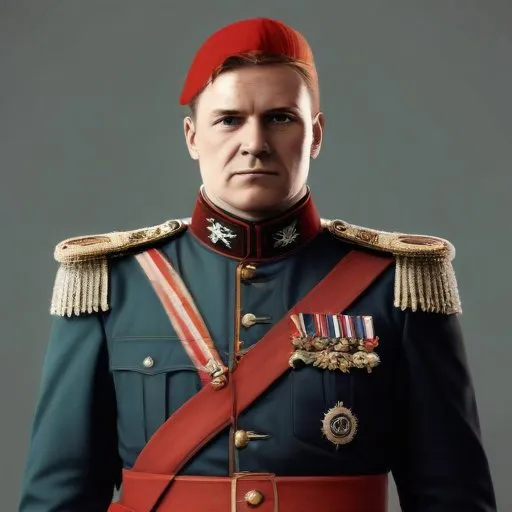
A German soldier and politician who served as a high-ranking officer in the Wehrmacht during World War II and later became a prominent figure in post-war German politics. He's known for his role in shaping Germany's post-war military and political landscape.
Siegmund Glcksmann was a prominent German-Jewish socialist politician who left an indelible mark on the political landscape of Poland in the 1920s and 1930s. As a key figure in the German minority socialist movement, he functioned as the party ideologue, representing the more Marxist-oriented wing of the movement.
Glcksmann was born on May 30, 1884. During his student years, he was drawn to socialist ideology, joining a socialist students' organization in Wadowitz. He later pursued law studies at the Jagiellonian University in Krakow, where he became involved with socialist publications.
In 1910, Glcksmann became a member of the Jewish Social Democratic Party (PSD), which later merged with the Jewish Social Democracy in Galicia to form a unified PSD. He was elected to the Executive of the PSD, solidifying his position as a rising star in the socialist movement.
Glcksmann's university studies were interrupted by the outbreak of World War I, during which he served as an officer, commanding a company of carabiners. After the war, he settled in Bielsko-Biala, where he established his own law practice and became an influential figure in local politics.
In Bielsko-Biala, Glcksmann was elected to the town council and played a key role in the Social Democratic electoral bloc Forward. He also worked with the press organ Volksstimme, further cementing his reputation as a leading socialist thinker.
In 1922, Glcksmann successfully merged the Bielitz branch of the Austrian Social Democratic Party with the German Social Democratic party organizations in Upper Silesia, forming the German Social Democratic Party (DSDP). The DSDP aimed to organize German socialists throughout the Polish republic, paving the way for the eventual formation of the German Socialist Labour Party in Poland (DSAP).
Siegmund Glcksmann's tireless efforts to promote socialist ideals and unify German socialists in Poland left a lasting legacy. His commitment to Marxist principles and his ability to bring together disparate factions earned him recognition as a visionary leader in the German minority socialist movement.
Through his work, Glcksmann inspired a generation of socialist activists and politicians, shaping the course of Polish politics in the interwar period. His unwavering dedication to the principles of social justice and equality continues to inspire and motivate people to this day.
Born in 1891
A renowned World War II military strategist, known for leading the Afrika Korps and earning the respect of both allies and enemies with his tactical genius.
Born in 1888
A pioneering tank commander who revolutionized modern warfare with his innovative blitzkrieg tactics, earning him the nickname "Father of the Panzerwaffe".
Born in 1880
A German field marshal who led the Wehrmacht during World War II, playing a key role in the invasion of Poland and the Battle of Moscow. He was a prominent figure in the German high command during the war.
Born in 1887
A highly decorated military strategist who played a crucial role in several key battles during World War II, including the invasion of France and the Siege of Leningrad.
Born in 1882
A high-ranking military officer who played a crucial role in World War II, particularly in the Battle of France and the plot to assassinate Adolf Hitler.
Born in 1891
A skilled and highly decorated military leader, known for his tactical genius and defensive strategies during World War II, earning him the respect of both his allies and enemies.
Born in 1893
A high-ranking Nazi official, he was a decorated World War I fighter pilot and later became a prominent politician, serving as Minister President of Prussia. He's infamous for his role in the Nazi regime and war crimes trials.
Born in 1882
A high-ranking Nazi officer who served as the Chief of the OKW, the German High Command, during World War II, and was known for his unwavering loyalty to Hitler. He was tried and executed for war crimes after the war.
