


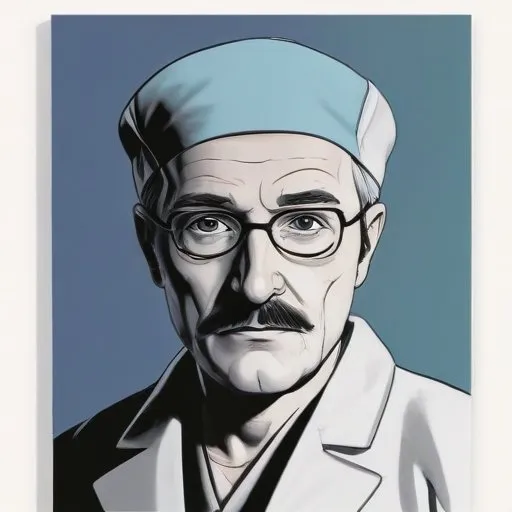
Pioneering French surgeon who developed innovative surgical techniques, including the first successful removal of a brain tumor.
Thodore Tuffier, a French surgeon, is renowned for his groundbreaking contributions to the fields of pulmonary and cardiovascular surgery, as well as spinal anaesthesia. He was a trailblazer in his time, performing numerous firsts in surgical procedures and leaving behind a legacy that continues to inspire medical professionals to this day.
Born on March 26, 1857, in Bellme, Orne, France, Tuffier began his medical journey as an intern in 1879. He was appointed a hospital surgeon in 1887 and initially worked at the Hpital de la Piti, followed by the Hpital Beaujon.
Tuffier's most enduring legacy is perhaps Tuffier's Line, an imaginary line connecting the iliac crests, used as a landmark for the Processus spinosus L4 to identify L4-5 vertebral interspace in spinal anaesthesia and lumbar puncture. This innovation has had a lasting impact on the field of medicine, making spinal anaesthesia and lumbar puncture safer and more effective.
Tuffier married Madeleine Herbault (1867-1940) and had two daughters, Jeanne and Gabrielle. He was also the last French owner of the Fragonard painting "A Young Girl Reading".
Tuffier's literary contributions have had a profound impact on the medical community, providing valuable insights and expertise in the fields of pulmonary and cardiovascular surgery, as well as spinal anaesthesia.
Thodore Tuffier's pioneering spirit, innovative mind, and dedication to his craft have left an indelible mark on the world of medicine. His legacy continues to inspire and educate medical professionals, ensuring his place in the annals of medical history.
Born in 1827
Pioneering antiseptic surgery, revolutionizing medical practices with germ-killing techniques, saving countless lives.
Born in 1822
Developed vaccines for rabies and anthrax, and pioneered the germ theory of disease, revolutionizing our understanding of microbiology and disease prevention.
Born in 1856
Pioneering psychoanalyst who developed theories on the subconscious mind, childhood experiences, and the structure of personality, revolutionizing our understanding of human behavior and psychology.
Born in 1867
A pioneering scientist who pioneered radioactivity research, discovering elements polonium and radium, and paving the way for breakthroughs in medicine and energy.
Born in 1859
A pioneer in radioactivity research, discovering elements like polonium and radium, and pioneering radioactive isolation techniques. Their groundbreaking work paved the way for advancements in medicine, energy, and materials science.
Born in 1852
Discovered radioactivity, a fundamental property of atoms, and pioneered research in the field, leading to breakthroughs in medicine, energy, and materials science.
Born in 1825
A pioneering neurologist and psychologist who laid the groundwork for modern psychiatry, particularly in the study of hysteria and hypnosis.
Born in 1813
Pioneering physiologist who introduced the concept of homeostasis, revolutionizing our understanding of the human body's internal balance and its response to environmental changes.
