


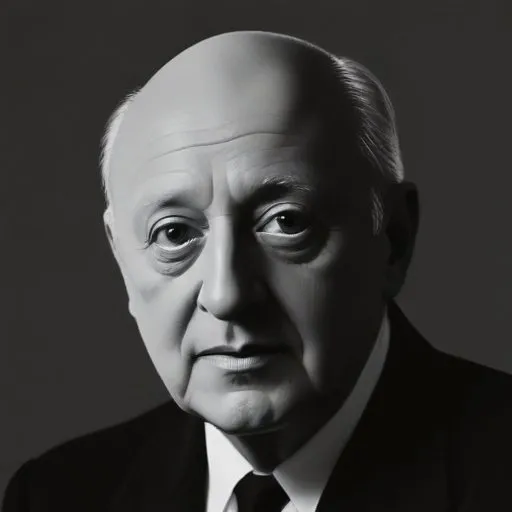
A pioneering composer and critic who blended jazz and classical music, creating a unique American sound, and wrote witty, influential music criticism.
Born on November 25, 1896, in Kansas City, Missouri, Thomson's childhood was marked by a strong affinity for music. He befriended Alice Smith, great-granddaughter of Joseph Smith, founder of the Latter-day Saint movement, and often played the organ at Grace Church. Following World War I, Thomson entered Harvard University, where he focused his studies on the piano work of Erik Satie. A fellowship allowed him to study in Paris for a year, and after graduating, he lived in the city from 1925 to 1940, immersed in the vibrant cultural scene.
In Paris, Thomson was influenced by several prominent French composers, including Darius Milhaud, Francis Poulenc, Arthur Honegger, Georges Auric, and Germaine Tailleferre, members of the esteemed group Les Six. He also studied with Nadia Boulanger, a renowned pedagogue and composer. Thomson's partnership with painter Maurice Grosser, his life partner and frequent collaborator, proved to be a defining aspect of his creative life. The couple's Parisian salon became a hub for prominent figures in music, art, and theater, including Leonard Bernstein and Tennessee Williams.
Thomson's compositional style defies categorization, blending elements of modernism, neoromanticism, and neoclassicism. His unique voice was characterized by a refined balance of humanity and detachment, often yielding works of subtle yet profound emotional depth. Notable compositions include his opera Lord Byron, which showcased an unprecedented level of passion and emotional intensity, as well as his scores for films such as The Plow That Broke the Plains and The River, which earned him Academy Award nominations.
A prolific critic, Thomson's writings on music and art were marked by a piercing intelligence and wit. His critiques, often penned for publications such as the New York Herald Tribune, offered insightful analyses of contemporary music and its cultural context. Thomson's legacy extends beyond his compositions to his role as a champion of American music, fostering a new generation of composers and critics. His influence can be seen in the works of composers such as Aaron Copland and Elliott Carter, who drew inspiration from his pioneering spirit and artistic vision.
Throughout his illustrious career, Thomson received numerous accolades, including three Pulitzer Prize nominations, a Guggenheim Fellowship, and a Brandeis Award. In 1969, he was awarded the National Medal of Arts, the highest honor bestowed upon an American artist.
Thomson's later years were marked by a continued commitment to composition and criticism. He passed away on September 30, 1989, leaving behind a rich cultural legacy that continues to inspire and influence generations of musicians, composers, and critics.
Born in 1874
A pioneering figure in modernist literature, known for experimental writing styles and influential salons that fostered artistic innovation. 82
Born in 1900
A renowned composer, conductor, and educator who blended folk and modernist elements to create iconic American classical music, including "Appalachian Spring" and "Fanfare for the Common Man".
Born in 1918
A renowned musician who blended jazz, classical, and Broadway styles, creating iconic works like West Side Story, and inspiring generations with his charismatic performances and innovative compositions.
Born in 1910
A renowned pianist and composer who blended romanticism and modernism, creating iconic works like "Adagio for Strings" that evoke powerful emotions.
Born in 1908
A pioneering composer of modern classical music, known for his complex and innovative works that pushed the boundaries of harmony and rhythm.
Born in 1910
A renowned composer and educator, he was the first president of the Juilliard School and won the Pulitzer Prize for Music in 1943. He's known for his contributions to American classical music.
Born in 1894
A renowned composer, theorist, and academic who made significant contributions to the development of American classical music, particularly in the realm of harmony and counterpoint.
Born in 1896
A renowned composer, conductor, and educator who made significant contributions to American classical music, particularly through his Romantic-style symphonies and leadership of the Eastman School of Music.
