


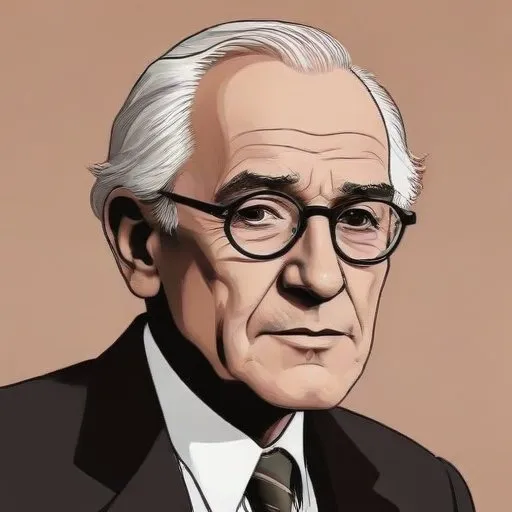
A prominent literary critic and poet, known for his conservative and formalist approach to poetry, advocating for a return to traditional forms and values. His critiques and poetry collections are still widely studied and admired today.
Yvor Winters, a renowned American poet and literary critic, left an indelible mark on the literary world with his unique blend of creative prowess and incisive criticism. Best known for his contributions to modern poetry and literary theory, Winters' work continues to influence contemporary writers and scholars alike.
Born on October 17, 1900, in Chicago, Illinois, Winters spent his formative years in the Midwest, with brief stints in Seattle and Pasadena. His early life was marked by a passion for literature, which was nurtured by his association with the University of Chicago's literary circle. This circle included notable writers like Glenway Wescott, Elizabeth Madox Roberts, and his future wife, Janet Lewis.
In 1923, Winters published one of his earliest critical essays, "Notes on the Mechanics of the Poetic Image," in the expatriate literary journal Secession. This essay marked the beginning of his career as a literary critic, which would go on to shape his poetic style and influence a generation of writers. Winters' critical voice was characterized by its piercing insight, precision, and a commitment to traditional literary values.
Winters' poetry is known for its formal elegance, precision, and intellectual rigor. His work is deeply rooted in the classical tradition, yet infused with a modern sensibility. Some of his notable poetry collections include The Immobile Wind, The Magpie, and To the Holy Spirit. His poetry is a testament to his mastery of form and his ability to craft language that is both beautiful and profound.
As a teacher and mentor, Winters had a profound impact on many notable writers, including Edgar Bowers, Thom Gunn, Donald Hall, Philip Levine, and Robert Pinsky, among others. His influence can be seen in the work of these poets, who credit him with shaping their literary vision. Winters' legacy extends beyond his poetry and criticism to his role as a guardian of literary tradition and a champion of intellectual rigor.
In recognition of his contributions to literature, Winters was awarded the 1961 Bollingen Prize in Poetry. This prestigious award was a testament to his stature as a poet and critic, and cemented his place as one of the most important literary figures of his time.
Winters married the poet and novelist Janet Lewis in 1926, and the couple's partnership was marked by a deep literary and personal connection. He taught at the University of Idaho and Stanford University, where he spent the majority of his academic career. Winters passed away on January 25, 1968, leaving behind a legacy that continues to inspire and influence writers to this day.
These quotes capture the essence of Winters' literary philosophy, emphasizing the importance of artistic craft and the role of the poet as a creator rather than an explainer.
Born in 1809
A master of dark and atmospheric storytelling, crafting haunting tales of mystery and horror that continue to captivate readers to this day.
Born in 1830
A reclusive poet who crafted innovative, enigmatic, and emotionally charged verse that continues to captivate readers with its unique style and profound insights.
Born in 1874
Pulitzer Prize-winning poet and playwright celebrated for rural New England-inspired works that explore human nature, morality, and the American experience.
Born in 1888
A renowned poet, playwright, and critic who reshaped modern poetry with works like "The Waste Land" and "Old Possum's Book of Practical Cats", influencing literature and art with their unique style.
Born in 1879
A modernist master of language and imagination, crafting innovative, symbolic poetry that explores the human experience and the relationship between reality and the individual's perception of it.
Born in 1883
A physician-turned-writer, known for his modernist poetry and short stories that explored the everyday lives of ordinary people, often using imagery and experimental styles. His work blurred the lines between poetry and prose, creating a unique literary voice.
Born in 1899
A leading figure of the New Criticism movement, known for his influential poetry and literary criticism that shaped modern American literature.
Born in 1888
A prominent figure in the New Criticism movement, known for his poetry and literary criticism that emphasized close reading and analysis of texts. He was also a founder of the Kenyon Review literary magazine.
