


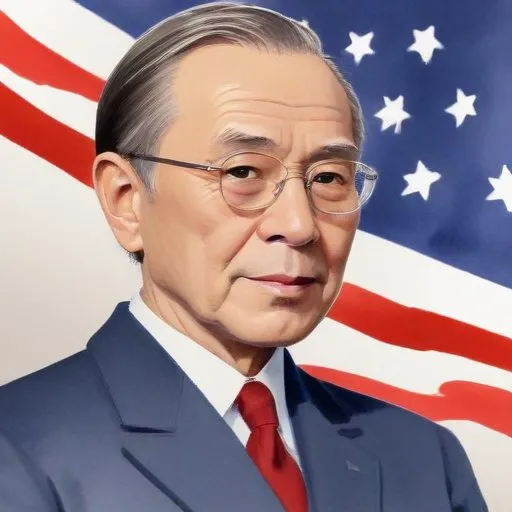
A renowned expert on Japan, he served as US Ambassador to Japan, fostering greater understanding and cooperation between the two nations. His work greatly influenced US-Japan relations and East Asian studies.
Edwin O. Reischauer, a renowned American diplomat, educator, and professor, is best known for his extraordinary contributions to the understanding and appreciation of East Asian cultures, particularly Japan and Korea. As a leading scholar and United States Ambassador to Japan from 1961 to 1966, Reischauer played a pivotal role in shaping US policy toward East Asia during and after World War II.
Born on October 15, 1910, in Tokyo, Japan, to American educational missionaries, Reischauer's early life was immersed in the rich cultural heritage of Japan. His father, August Karl Reischauer, helped found the Tokyo Women's Christian University, while his mother, Helen Sidwell Oldfather, established the Japan Deaf Oral School, the first of its kind in Japan. Reischauer's unique upbringing instilled in him a deep appreciation for Asian cultures, which would later drive his academic and diplomatic pursuits.
Reischauer's academic excellence earned him a Bachelor of Arts degree from Oberlin College in 1931. He later pursued his Ph.D. from Harvard University, which he completed in 1939 with a dissertation on the Japanese monk Ennin's travelogues in Tang China. This comprehensive work showcased Reischauer's mastery of Asian languages and cultures, cementing his reputation as a leading scholar in the field.
One of Reischauer's most notable contributions is the McCune-Reischauer romanization of the Korean language, developed in collaboration with George M. McCune in 1939. This groundbreaking system has remained the standard for romanizing Korean script to this day.
In 1961, President John F. Kennedy appointed Reischauer as the United States Ambassador to Japan, a position he held until 1966. During this tenure, Reischauer worked tirelessly to strengthen US-Japan relations, fostering greater understanding and cooperation between the two nations. His diplomatic efforts helped to lay the foundation for a more peaceful and prosperous Asia-Pacific region.
In 1973, Reischauer founded the Japan Institute at Harvard University, which was later renamed in his honor. This esteemed institution continues to promote advanced research and education on Japan and East Asia, reflecting Reischauer's enduring legacy in the field.
Throughout his remarkable career, Reischauer received numerous awards and honors for his contributions to international relations, education, and Asian studies. His work has inspired generations of scholars, diplomats, and policymakers, ensuring a lasting impact on US-Asia relations and beyond.
Edwin O. Reischauer's extraordinary life and achievements serve as a testament to the power of dedication, scholarship, and diplomacy. His remarkable legacy continues to inspire and educate, bridging cultural divides and fostering a deeper understanding between nations.
Born in 1888
A prominent Cold War diplomat who served as Secretary of State under President Dwight D. Eisenhower, known for his anti-communist foreign policy and role in shaping the United States' response to the Soviet Union.
Born in 1893
The 51st United States Secretary of State played a crucial role in shaping post-World War II foreign policy, particularly in the formation of the Marshall Plan and the creation of NATO. He was a key figure in the Cold War era.
Born in 1880
A highly decorated military leader and statesman who played a crucial role in shaping post-WWII foreign policy and was awarded the Nobel Peace Prize for his efforts. He's most known for authoring the Marshall Plan, a massive economic aid program that helped rebuild war-torn Europe.
Born in 1880
A highly decorated war hero and master strategist who led troops to victory in World War I and II, and later became a prominent figure in the occupation of Japan.
Born in 1901
The Japanese emperor who ruled from 1926 to 1989, leading the country through World War II and its post-war reconstruction, and is known for his symbolic role in Japanese politics and culture. He is also remembered for his rare public apology for Japan's wartime atrocities.
Born in 1878
A post-WWII Japanese leader who played a crucial role in rebuilding and democratizing Japan, known for his efforts to restore relations with the West.
Born in 1901
A Japanese politician who served as Prime Minister from 1964 to 1972, known for his efforts to normalize relations with South Korea and winning the Nobel Peace Prize in 1974.
Born in 1905
The 67th Prime Minister of Japan, serving from 1976 to 1978, known for his efforts to improve Japan's relations with Southeast Asia and his role in normalizing Japan's relations with China.
