


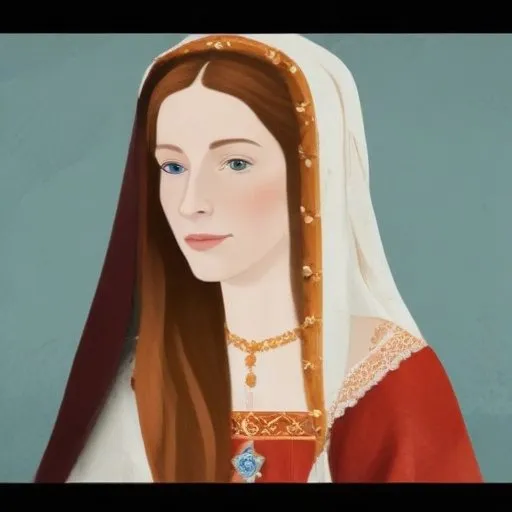
Daughter of King Edward IV, she married John de la Pole, 2nd Duke of Suffolk, and played a significant role in the Tudor family's rise to power. She's known for her strategic marriages and family alliances.
Elizabeth of York, Duchess of Suffolk, was a pivotal figure in the tumultuous landscape of 15th-century England, known for herfamily ties to the powerful House of York and her marriage to John de la Pole, 2nd Duke of Suffolk. As the sister of two English monarchs, Edward IV and Richard III, Elizabeth's life was inextricably linked to the royal court, influencing the course of English history in subtle yet significant ways.
Born on April 22, 1444, Elizabeth was the sixth child and third daughter of Richard Plantagenet, 3rd Duke of York, and Cecily Neville. Her birth marked the beginning of a life immersed in the intrigues of the noble classes, where alliances and marriages could make or break dynasties.
Sometime before February 1458, Elizabeth married John de la Pole, the eldest son of William de la Pole, 1st Duke of Suffolk, and Alice Chaucer. This union was a calculated move to strengthen ties between the House of York and the powerful de la Pole family, which had significant influence over the English court.
Elizabeth's life was marked by the ebbs and flows of her family's fortunes. Her father-in-law, William de la Pole, had served as the principal power behind the throne for Henry VI of England from 1447 to 1450, but his failure to stem the loss of English possessions in northern France led to his imprisonment and eventual execution. This chain of events saw Elizabeth's husband, John, stripped of his titles and inheritance.
However, with the ascension of her brother Edward IV to the throne in 1461, John was restored to his dukedom in 1463, and Elizabeth became the Duchess of Suffolk. The couple settled in Wingfield, Suffolk, where they raised their family and navigated the treacherous waters of royal politics.
Elizabeth and John had five children together, each playing important roles in the complex web of alliances and rivalries that defined the era:
Elizabeth outlived her husband by nearly a decade, passing away in 1503. She was buried in the church in Wingfield, Suffolk, a testament to her enduring presence in the region. Through her children and her family ties, Elizabeth played a significant, if often overlooked, role in shaping the course of English history.
Hers is a story of devotion, adaptation, and resilience, one that serves as a reminder of the intricate web of relationships that underpinned the grand narratives of medieval England.
Born in 1133
King of England from 1154 to 1189, known for establishing a strong centralized government, reforming the English church, and his tumultuous relationships with Thomas Becket and his sons.
Born in 1466
Daughter of King Edward IV, she married Henry VII, uniting the Houses of York and Lancaster, and was the mother of Henry VIII, establishing the Tudor dynasty.
Born in 1489
Daughter of an English king, she married a Scottish king, uniting the thrones and paving the way for the eventual union of the crowns. She played a key role in Scottish politics and cultural development.
Born in 1491
A larger-than-life monarch who ruled England with an iron fist, infamous for his six marriages and the English Reformation.
Born in 1485
Spanish princess who became the queen consort of England, playing a central role in the English Reformation and sparking the creation of the Church of England.
Born in 1478
A renowned Renaissance humanist and statesman who served as Lord Chancellor of England, famous for his literary work "Utopia" and his martyrdom for refusing to acknowledge the English monarch's supremacy over the Church.
