


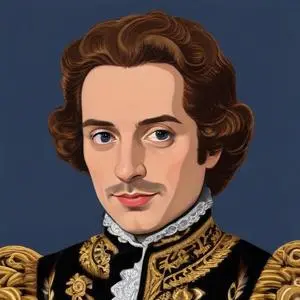
A charming and influential royal courtier who played a significant role in shaping English politics during the 17th century, known for his cunning and ambition.
George Villiers, 2nd Duke of Buckingham, was a prominent English statesman and poet who wielded considerable political power during the reign of Charles II of England. He was a key member of the Cabal ministry in 1668 and rose to become one of the king's most influential advisors.
Born on January 30, 1628, George Villiers was the son of George Villiers, 1st Duke of Buckingham, a favorite of James I and Charles I, and his wife Katherine Manners. After his father's assassination, he was brought up in the royal household of Charles I, alongside his younger brother Francis and the king's own children, the future Charles II and James II.
He received his education at Trinity College, Cambridge, where he obtained the degree of Master of Arts in 1642. During this time, he was taught geometry by the renowned philosopher Thomas Hobbes.
During the English Civil War, Villiers fought for the king and took part in Prince Rupert of the Rhine's attack on Lichfield Close in April 1643. After the war, he traveled abroad with his brother, living in Florence and Rome under the care of the Earl of Northumberland.
In 1651, Villiers joined Charles II's court-in-exile in France, only to return to England in 1657 after a disagreement with the king. However, he subsequently supported the Stuart Restoration in 1660 and rose to become a key member of the Cabal ministry in 1668.
Despite being imprisoned by Charles II on several occasions, Villiers continued to exert significant influence over the king, becoming one of his most trusted advisors.
Villiers had a lifelong interest in science and poetry, and was the author of several satires and plays. His literary works showcased his wit and humor, earning him recognition in literary circles.
Villiers' personal life was marred by controversy, with frequent imprisonments and disagreements with the king. Despite this, he remained a prominent figure in English politics, continuing to influence the monarchy until his death on April 16, 1687.
George Villiers, 2nd Duke of Buckingham, left an indelible mark on English history, both as a statesman and a poet. His influence on the monarchy and his contributions to literature continue to be studied and appreciated by scholars today.
Born in 1599
Leader of the Parliamentarian forces during the English Civil War, who later ruled England, Scotland, and Ireland as a republican dictator, known for his military victories and radical reforms.
Born in 1573
A 17th-century poet and cleric who penned powerful, metaphysical sonnets that explored themes of love, death, and spirituality. His works are celebrated for their complex, intricate language and profound insights into the human experience.
Born in 1572
A prominent figure in the English Renaissance, known for his witty plays and poems that explored themes of love, power, and morality. His works continue to influence literature and theater to this day.
Born in 1593
A metaphysical poet and Anglican priest, he crafted intricate, symbolic, and introspective verse that explored the human condition and spirituality. His poetry is revered for its lyricism, depth, and emotional resonance.
Born in 1621
A 17th-century poet and politician who wrote lyrical and metaphysical verse, as well as satirical attacks on the government, blending art and politics in his work.
Born in 1631
A dominant literary figure of the Restoration era, known for his influential poetry, plays, and critical essays that shaped the English literary landscape. He's often credited with creating a new style of heroic drama and satire.
