


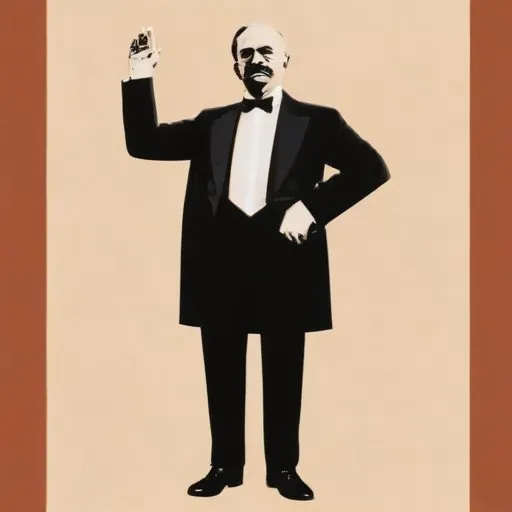
A Polish-American maestro who led orchestras in the US and Japan, known for his innovative programming and championing of modern composers.
Joseph Rosenstock, a renowned Polish-American conductor, is best known for his remarkable contributions to the world of opera, leading orchestras across the globe, and premiering iconic works by prominent composers.
Rosenstock was born on January 27, 1895, in Kraków, Poland. He began his career in Germany, working at the State Theatre in Darmstadt and the State Opera in Wiesbaden, where he conducted premieres of works by Karol Szymanowski and Ernst Krenek.
In 1928, Rosenstock was invited to conduct at the Metropolitan Opera in New York City, replacing Artur Bodanzky. However, his American debut was short-lived, as he received unfavorable reviews and resigned after only six performances. Bodanzky was subsequently reinstated.
Returning to Germany, Rosenstock worked in Mannheim and later became the conductor of the Berlin Jüdischer Kulturbund, a cultural organization that provided a safe haven for Jewish artists during the Nazi era. In 1935, he conducted the all-Jewish German premiere of Verdi's Nabucco.
In 1936, Rosenstock fled Nazi Germany and moved to Tokyo, where he conducted the Japan Symphony Orchestra (later renamed the NHK Symphony Orchestra). During his 10-year tenure, he mentored notable conductors, including Hideo Saito and Masashi Ueda.
In 1948, Rosenstock returned to New York City, where he joined the New York City Opera (NYCO) as a conductor. In 1951, he premiered David Tamkin's The Dybbuk. The following year, he succeeded Laszlo Halász as General Director of the NYCO, serving for four seasons and continuing Halász's innovative programming.
Rosenstock's conducting style was characterized by his emphasis on dramatic expression and his ability to balance orchestral and vocal elements. He was dedicated to promoting new and innovative works, often taking risks to premiere compositions that would later become classics.
Rosenstock's tireless efforts to promote opera and classical music helped to democratize these art forms, making them more accessible to a broader audience. His influence can be seen in the many conductors and musicians he mentored, who went on to shape the musical landscape of the 20th century.
Joseph Rosenstock's remarkable career spanned continents and decades, leaving an indelible mark on the world of opera and classical music. His life's work serves as a testament to the power of art to transcend borders and overcome adversity.
Rosenstock passed away on October 17, 1985, in New York City, but his legacy lives on through the many musicians and conductors he inspired, and the countless performances of opera and classical music that continue to enrich our lives.
Born in 1867
A renowned conductor who led the NBC Symphony Orchestra and was known for his intense performances and perfectionism, shaping the sound of classical music in the 20th century.
Born in 1886
A renowned German conductor and composer, he was a dominant figure in the Berlin Philharmonic, known for his intense and expressive performances of Beethoven, Brahms, and Bruckner. He was also a composer of symphonies and other works.
Born in 1876
A renowned pianist, composer, and conductor who led the Vienna Philharmonic and New York Philharmonic, known for his interpretations of Mozart, Mahler, and Bruckner.
Born in 1897
A renowned conductor and composer, known for his precise and expressive performances, leading the Cleveland Orchestra to international acclaim. His interpretations of classical music remain highly influential.
Born in 1899
A renowned violinist and conductor, leading the Philadelphia Orchestra for over 40 years, known for his technical precision and interpretations of Romantic-era composers.
Born in 1882
A renowned conductor who revolutionized the art of orchestral performance with his innovative techniques and charismatic stage presence, leading iconic ensembles like the Philadelphia Orchestra.
Born in 1874
A renowned bassist, composer, and conductor who led the Boston Symphony Orchestra for 25 years, introducing many American premieres of works by prominent composers. He was a champion of modern classical music.
Born in 1918
A renowned musician who blended jazz, classical, and Broadway styles, creating iconic works like West Side Story, and inspiring generations with his charismatic performances and innovative compositions.
