


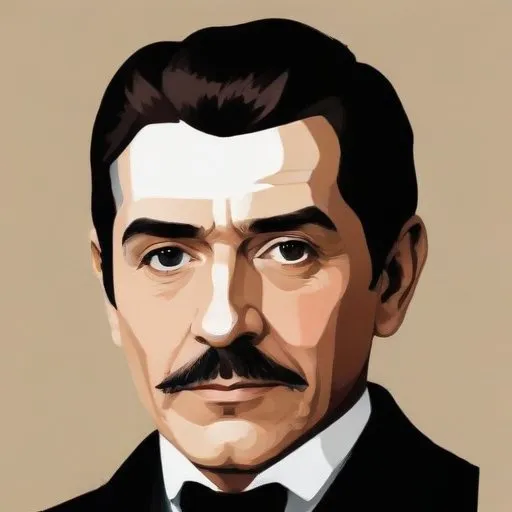
Wrote influential satirical novels, such as "Erewhon", that critiqued Victorian society and explored utopian ideals.
Samuel Butler, the 19th-century English novelist and critic, is best known for his scathing satire, Erewhon, and his semi-autobiographical novel, The Way of All Flesh. These two works, published in 1872 and 1903, respectively, have remained in print since their initial publication, cementing Butler's reputation as a trenchant social commentator and a master of wit and irony.
Butler was born on December 4, 1835, at the rectory in Langar, Nottinghamshire, to Rev. Thomas Butler and his wife, Fanny Worsley. His father, a clergyman, was the son of Dr. Samuel Butler, a former headmaster of Shrewsbury School and later Bishop of Lichfield. Butler's education began at home, where he was subject to regular beatings, a common practice at the time. He later recorded that his parents were "brutal and stupid by nature," and that his father "never liked me, nor I him."
Butler's first novel, Erewhon, is a scathing satire of Victorian society, presenting a utopian society that is, in fact, a dystopia. The novel's clever inversion of conventional values and its witty, ironic tone established Butler as a bold and innovative thinker. Erewhon is still widely read today, and its influence can be seen in the work of later satirists, such as Aldous Huxley and George Orwell.
Butler's second novel, The Way of All Flesh, is a semi-autobiographical work that draws heavily on his own experiences as a child and young man. The novel tells the story of Ernest Pontifex, a young man struggling to break free from the constraints of his family and society. Initially published in 1903, The Way of All Flesh was heavily revised by Butler, and the original, uncensored version was not published until 1964.
Butler's work is characterized by its skeptical, questioning attitude towards established authority and tradition. He was deeply interested in evolutionary thought and was one of the first to recognize the significance of Charles Darwin's ideas. Butler's own philosophical views were shaped by his reading of German philosophers, such as Arthur Schopenhauer and Friedrich Nietzsche.
Butler's influence can be seen in a wide range of fields, from literature to philosophy to art. His satire and social commentary have inspired generations of writers, from E.M. Forster to Martin Amis. His philosophical ideas have influenced thinkers such as Bertrand Russell and A.J. Ayer.
Butler's life was marked by his struggles with his family and society. He never married and lived a largely solitary life, devoting himself to his writing and intellectual pursuits. He died on June 18, 1902, at the age of 66, leaving behind a body of work that continues to challenge and delight readers to this day.
"The wisdom of the wise and the experience of the ages are all on the side of the thought that the sole cause of man's unhappiness is that he does not know how to stay quietly in his room."
"Life is the art of drawing sufficient conclusions from insufficient premises."
Samuel Butler's work is a testament to the power of satire and social commentary to challenge and subvert established authority. His influence can be seen in a wide range of fields, from literature to philosophy to art. Today, Butler is recognized as one of the most important and innovative thinkers of the Victorian era, and his work continues to inspire and delight readers around the world.
Born in 1809
Developed the theory of evolution through natural selection, revolutionizing our understanding of life on Earth. This groundbreaking idea transformed the fields of biology, ecology, and beyond.
Born in 1823
A pioneering naturalist who discovered evolution through natural selection, independently of Charles Darwin, and contributed significantly to the field of biogeography.
Born in 1825
A prominent figure in the scientific community, known for advocating Charles Darwin's theory of evolution and coining the term "agnostic" to describe his own religious views.
Born in 1820
A pioneering thinker who coined the phrase "survival of the fittest" and applied evolutionary principles to social sciences, shaping modern sociology and philosophy.
Born in 1806
A prominent 19th-century thinker who championed individual liberty, free speech, and women's rights, and is best known for his influential book "On Liberty".
Born in 1819
A renowned 19th-century English novelist and poet, celebrated for crafting complex, psychologically nuanced characters and exploring social issues in works like "Middlemarch" and "Silas Marner".
Born in 1795
A 19th-century historian, philosopher, and academic who wrote influential works on history, politics, and society, particularly "The French Revolution" and "On Heroes, Hero-Worship, and The Heroic in History".
Born in 1812
A Victorian-era literary giant, renowned for crafting intricate, psychologically nuanced poetry and plays that probed the human condition, often exploring themes of love, death, and the nature of existence.
