


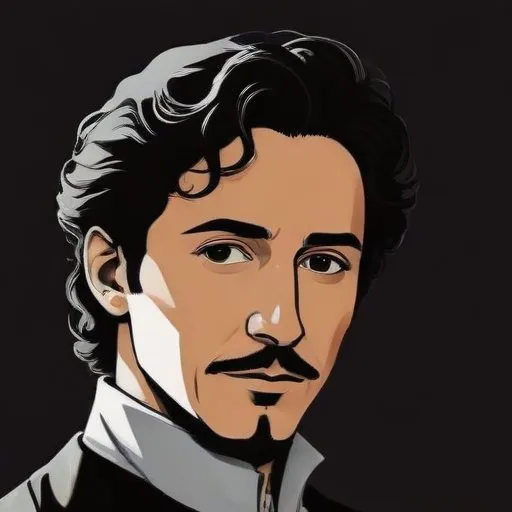
Baroque composer of operas and sacred music, particularly famous for his Stabat Mater, a revered and widely performed choral work.
Emanuele d'Astorga, an Italian composer, is renowned for his monumental work, the Stabat Mater, a masterpiece that has stood the test of time. This sacred composition, penned in the early 18th century, has become a cornerstone of classical music, resonating with audiences for generations.
Despite his significant contribution to the world of music, Astorga's life remains shrouded in mystery. The scarcity of reliable records and contradictory accounts have led to a tangled web of conjectures and speculations. However, it is certain that he was born on March 20, 1680, in Augusta, Sicily, to a noble family.
Astorga's early life was marked by tragedy when his father, a baron, was publicly executed for participating in a rebellion against Spanish rule. This horrific event had a profound impact on the young composer, leaving him in a state of melancholy and despair. The intervention of the Princess of Ursini, who offered him refuge in a convent in Astorga, Spain, proved to be a turning point in his life.
Under the guidance of skilled masters, Astorga honed his musical talents, finding solace in the world of harmony and melody. His musical education, begun in Palermo under Francesco Scarlatti, was further refined in the convent, where he composed some of his most notable works.
In 1713, Astorga's Stabat Mater was performed in Oxford, England, to great acclaim. This majestic work, featuring 10 voices and orchestral accompaniment, is a testament to the composer's skill and artistry. Its beauty and emotion have made it a beloved classic, with performances spanning centuries.
Astorga's life was marked by a series of journeys, taking him to Barcelona, London, Vienna, and Lisbon. During this time, he composed various works, including operas and chamber music. One of his few published pieces, Cantate da camera, was released in Lisbon in 1726.
The later years of Astorga's life are shrouded in mystery, with little known about his final days. It is believed that he retired to Bohemia, where he lived out the remainder of his life in relative seclusion.
Emanuele d'Astorga's contribution to classical music is immeasurable. His Stabat Mater remains an iconic work, cherished by audiences worldwide. Though his life was marked by tragedy and uncertainty, his music continues to inspire and uplift, a testament to the power of artistic genius.
Astorga's life may be a mystery, but his music is a testament to his enduring legacy, a reminder of the transformative power of art to transcend time and adversity.
Born in 1660
Baroque-era mastermind behind over 600 cantatas, operas, and orchestral works, shaping the course of classical music with his innovative style and harmonic genius.
Born in 1710
A Baroque composer, violinist, and organist who made significant contributions to the development of opera and sacred music, particularly with his famous "Stabat Mater" composition.
Born in 1714
A prominent composer of the Neapolitan School, he wrote over 80 operas and was a key figure in the transition between the Baroque and Classical periods. His music was known for its dramatic intensity and expressive melodies.
Born in 1727
An 18th-century master of opera, known for his innovative and expressive compositions that blended Italian and French styles, influencing the development of opera seria.
Born in 1728
An 18th-century Italian composer and educator, known for his operas and influence on the development of classical music. He was a prominent figure in the Neapolitan school of opera composition.
Born in 1749
An 18th-century Italian composer and educator, known for his operas and sacred music, particularly his comic operas that showcased his mastery of melody and harmony.
Born in 1740
An 18th-century Italian composer and educator, known for his operas and contributions to the development of classical music. His works were widely performed and admired by European royalty and aristocracy.
Born in 1714
A pioneering opera composer who revolutionized the art form with his innovative and expressive works, blending music and drama in a way that captivated audiences.
