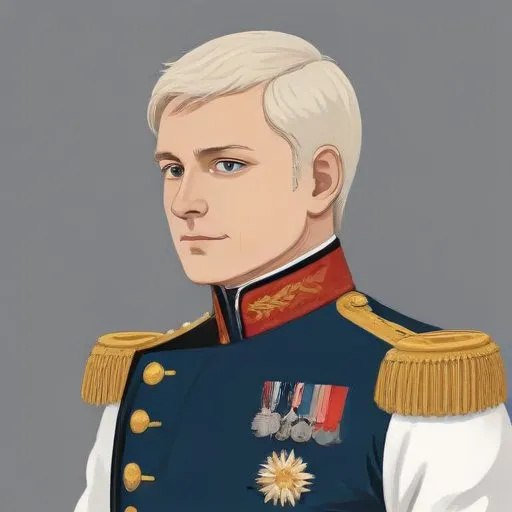
Prince Augustus William of Prussia: The Ill-Fated Heir and Military Commander
A Brief Overview
Prince Augustus William of Prussia, born on August 9, 1722, was a prominent figure in 18th-century European politics, known for his military prowess and his tumultuous relationship with his brother,
Frederick the Great. As the heir presumptive to the Prussian throne, Augustus played a significant role in the region's military campaigns, earning recognition for his bravery and strategic thinking.
Early Life and Family
Prince Augustus William was the second surviving son of King
Frederick William I of Prussia and Sophia Dorothea. His siblings included Wilhelmina, later the Margravine of Bayreuth, Frederick II, later King of Prussia, Friedrike Louise, later the Margravine of Ansbach, and Louisa Ulrika, later Queen consort of Sweden. Augustus's early life was marked by his father's favoritism, with King Frederick William I preferring him over Frederick, who would later become King.
Military Career
Augustus's military career was initially marked by success, with him distinguishing himself in the War of the Austrian Succession. He served as a general under his brother Frederick's command, showcasing his military acumen in the Battle of Hohenfriedberg. However, his fortunes took a turn for the worse during the Seven Years' War, when he was criticized for his leadership in the Battle of Kolin in 1757. This led to a public rift with his brother, resulting in Augustus's withdrawal from the army.
Personal Life and Marriage
Prince Augustus William married Luise of Brunswick-Wolfenbüttel, with whom he had several children. His oldest son, Frederick William II, would later inherit the throne of Prussia following Frederick's death. Augustus's personal life was marred by his complicated relationship with his brother, which was marked by periods of conflict and estrangement.
Legacy and Death
Prince Augustus William's life was cut short when he died suddenly on June 12, 1758, at the age of 35. While some attributed his death to a broken heart, following his brother's harsh treatment, it is believed that he succumbed to a brain tumor. Despite his tumultuous relationship with Frederick, Augustus's military career and legacy were shaped by his service to his brother and his contributions to Prussia's military campaigns.
Impact on Prussian History
Prince Augustus William's complex relationship with his brother had significant implications for Prussia's history. His military failures and subsequent withdrawal from the army led to a re-evaluation of Prussia's military strategy, with Frederick ultimately adopting a more defensive approach. Augustus's legacy serves as a reminder of the intricate web of family dynamics and military politics that shaped the course of European history.
Comparative Analysis with Contemporaries
When compared to his contemporaries, Prince Augustus William's military career was marked by both brilliance and failure. While he demonstrated bravery and tactical prowess in early battles, his later failures led to a re-assessment of his abilities. In contrast, his brother Frederick the Great is remembered as one of the greatest military minds in history, with his campaigns shaping the course of European politics. Augustus's legacy serves as a reminder of the complexities of Prussian politics and the intricate relationships between its rulers.
Timeline of Major Events
- 1722: Born on August 9
- 1740: Becomes heir presumptive to the Prussian throne upon Frederick's ascension
- 1744: Marries Luise of Brunswick-Wolfenbüttel
- 1757: Fights in the Battle of Kolin during the Seven Years' War
- 1758: Dies on June 12, at the age of 35
FAQ
What was Prince Augustus William of Prussias role in the royal family?
Prince Augustus William of Prussia was a member of the House of Hohenzollern, serving as a prince, military leader, and politician. He played a key role in shaping Prussias history and foreign policy.
How did Prince Augustus William contribute to Prussias military?
Prince Augustus William was a skilled military leader, participating in several battles and campaigns. He modernized Prussias military, introducing reforms that enhanced its strength and efficiency.
What were Prince Augustus Williams cultural achievements?
Prince Augustus William was a patron of the arts, supporting prominent artists, writers, and musicians. He encouraged cultural exchange and sponsored various cultural institutions, enriching Prussias cultural landscape.
What was Prince Augustus Williams relationship with Frederick the Great?
Prince Augustus William was a close ally and advisor to Frederick the Great, supporting his military campaigns and diplomatic initiatives. Their collaborative efforts shaped Prussias destiny.
How is Prince Augustus William remembered in Prussia?
Prince Augustus William is remembered as a dedicated leader, military strategist, and cultural patron. His legacy is celebrated through various monuments, museums, and cultural events in Prussia.